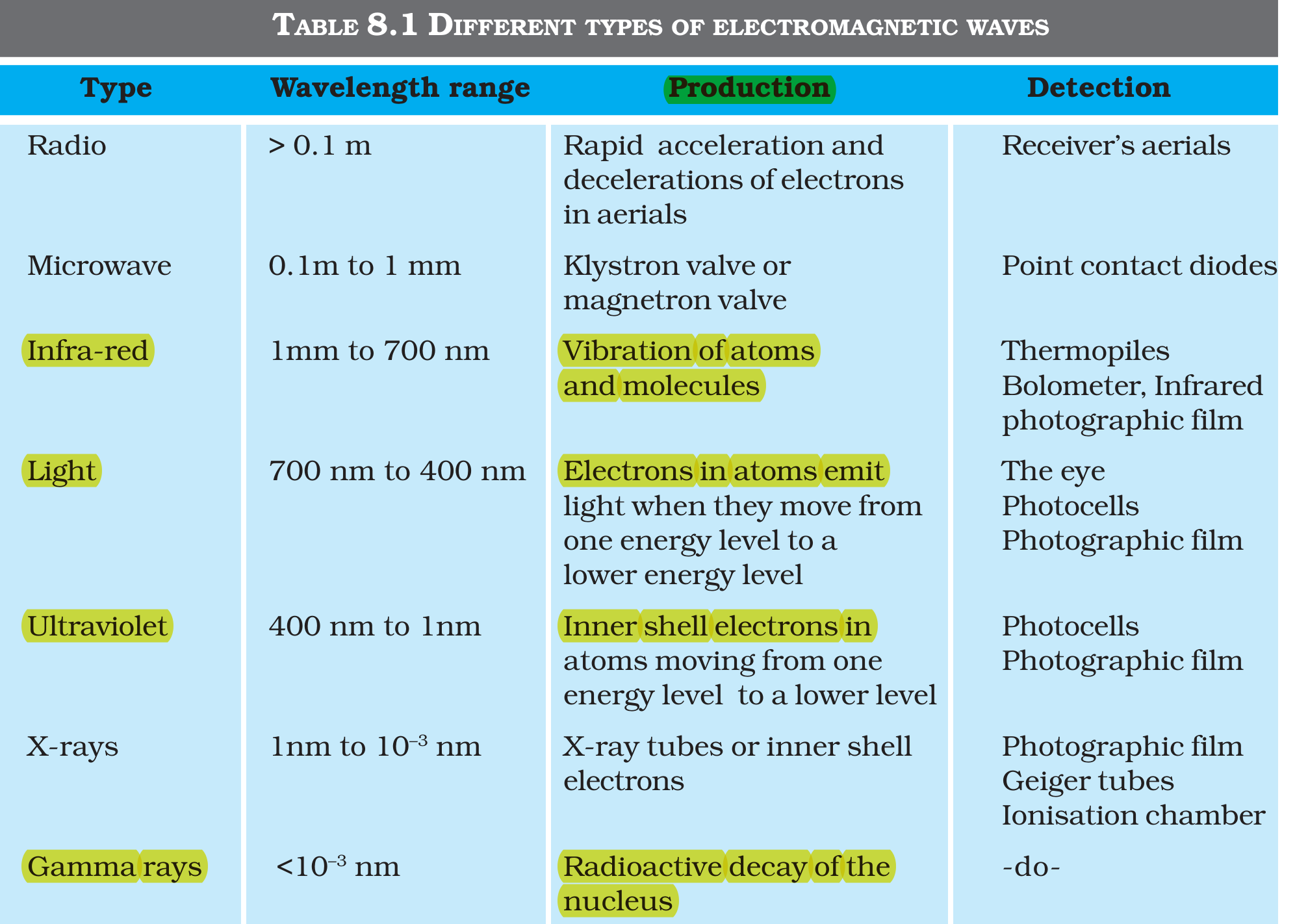
Match List-I with List-II
| List-I | List-II | ||
| (Electromagnetic Waves) | (Production) | ||
| (A) | Visible Light | (I) | Radioactive decay of the nucleus |
| (B) | Ultraviolet | (II) | Vibration of atoms and molecules |
| (C) | Infrared | (III) | Electrons in atoms moving from one energy level to a lower energy level |
| (D) | Gamma Rays | (IV) | Inner shell electrons in atoms moving from one energy level to a lower energy level |
Choose the correct answer from the options given below:
Answer & explanation
Correct answer: option 2
The correct answer is Option (2) → (A) - (III), (B) - (IV), (C) - (II), (D) - (I)
The source of each radiation is linked to its photon energy: the larger the energy change that produces it, the higher the frequency.
(A) Visible Light — this matches (III) Electrons in atoms moving from one energy level to a lower energy level. Transitions of the outer electrons release a few eV, which is visible light.
(B) Ultraviolet — this matches (IV) Inner shell electrons in atoms moving from one energy level to a lower energy level. Transitions of more tightly bound, inner electrons release larger energies, in the ultraviolet (and, for the innermost shells of heavy atoms, X-rays).
(C) Infrared — this matches (II) Vibration of atoms and molecules. Molecular vibrations involve small energies, so hot bodies radiate infrared.
(D) Gamma Rays — this matches (I) Radioactive decay of the nucleus. Nuclear energy changes are of the order of MeV, giving gamma rays.
NCERT (2026-27):
Gamma Rays – …