Read the passage and answer the questions:
Vijayanagara Empire: Architecture
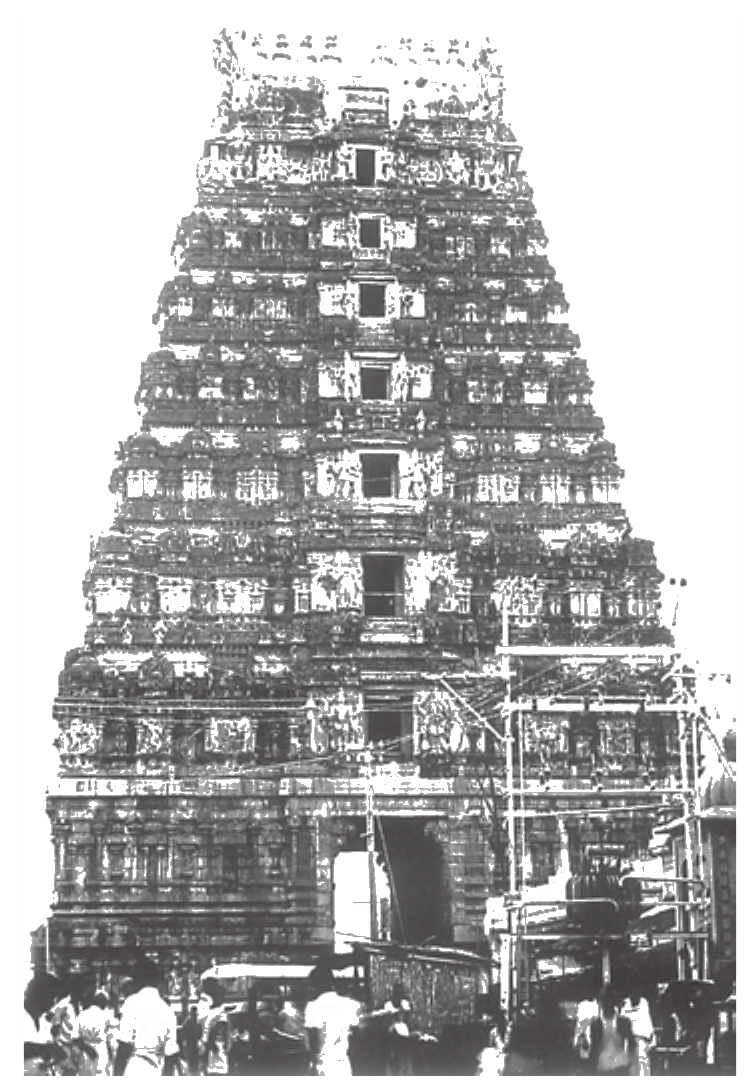
In terms of temple architecture, by this period certain new features were in evidence. These included structures of immense scale that must have been a mark of imperial authority, best exemplified by the raya gopurams or royal gateways that often dwarfed the towers on the central shrines, and signalled the presence of the temple from a great distance. They were also probably meant as reminders of the power of kings, able to command the resources, techniques and skills needed to construct these towering gateways. Other distinctive features include mandapas or pavilions and long, pillared corridors that often ran around the shrines within the temple complex. Let us look at two temples more closely – the Virupaksha temple and the Vitthala temple. The Virupaksha temple was built over centuries. While inscriptions suggest that the earliest shrine dated to the ninth-tenth centuries, it was substantially enlarged with the establishment of the Vijayanagara Empire. The hall in front of the main shrine was built by Krishnadeva Raya to mark his accession. This was decorated with delicately carved pillars. He is also credited with the construction of the eastern gopuram. These additions meant that the central shrine came to occupy a relatively small part of the complex. The halls in the temple were used for a variety of purposes. Some were spaces in which the images of gods were placed to witness special programmes of music, dance, drama, etc. Others were used to celebrate the marriages of deities, and yet others were meant for the deities to swing in. Special images, distinct from those kept in the small central shrine, were used on these occasions.
In terms of temple architecture, what was the best example of structures with immense scale which marked imperial authority in Vijayanagara?
Answer & explanation
Correct answer: option 2
The correct answer is Option (2) → Gopuram
The passage says that the new temple structures of immense scale, which must have been a mark of imperial authority, were best seen in the raya gopurams or royal gateways. These gateways often dwarfed the towers on the central shrines and signalled the presence of the temple from a great distance. They also reminded people of the power of kings, who could command the resources and skills needed to build them.
Note: This passage is taken from the NCERT chapter ‘An Imperial Capital: Vijayanagara’, almost word for word. Treat every paragraph of the chapter as a possible passage: a student who has read it closely answers these five questions from memory.
NCERT (2025-26): “5.2. Gopurams and mandapas … In terms of temple architecture, by this period certain new features were in evidence. These included structures of immense scale that must have been a mark of imperial authority, best exemplified by the raya gopurams (Fig. 7.7) or royal gateways that often dwarfed the towers on the central shrines, and signalled the presence of the temple from a great… distance. They were also probably meant as reminders of the power of kings, able to command the resources, techniques and skills needed to construct these towering gateways. Other distinctive features include mandapas or pavilions and long, pillared corridors that often ran around the shrines within the temple complex.…”
Fig. 7.7 A gopuram |