
The hybridization of carbonyl carbon changes from ...... to .........in a nucleophilic addition reaction.
Answer & explanation
Correct answer: option 1
The correct answer is Option (1) → sp2 , sp3
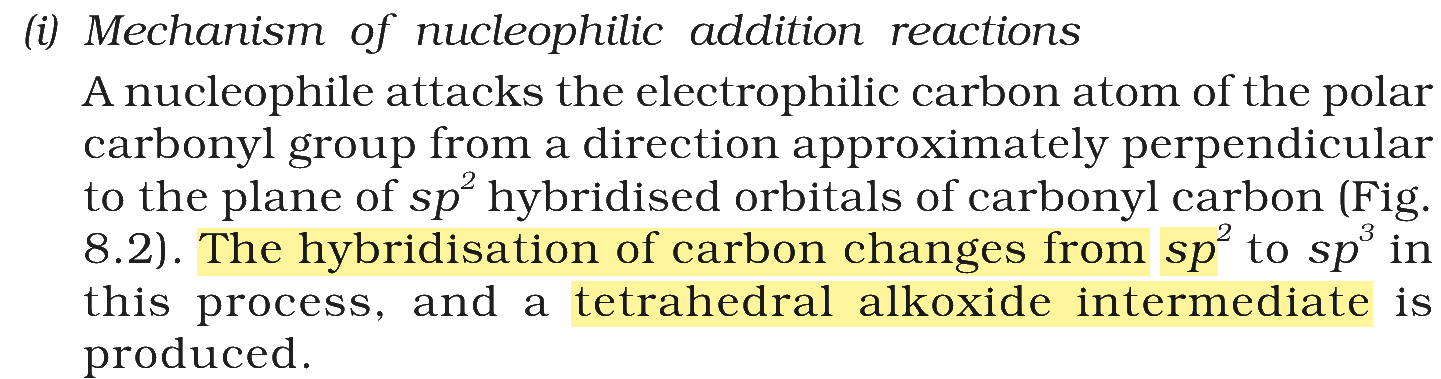
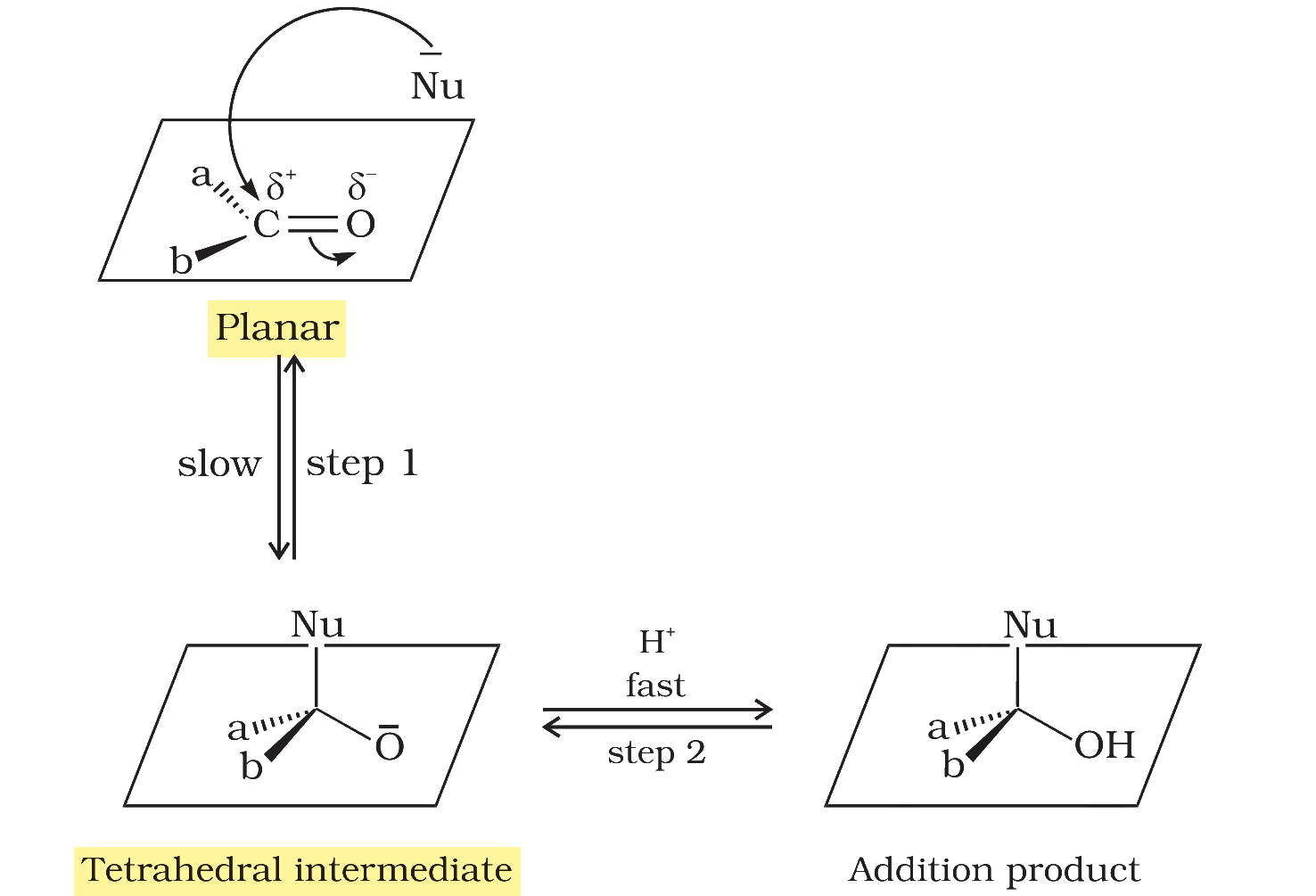
The carbonyl carbon of an aldehyde or ketone is \(sp^2\) hybridised: it forms three \(\sigma\) bonds in one plane (trigonal planar, bond angles about 120°) and a \(\pi\) bond with oxygen. In a nucleophilic addition the nucleophile attacks this carbon from above or below the plane. The \(\pi\) bond breaks, its electron pair moves onto oxygen, and the carbon now carries four \(\sigma\) bonds, so it becomes \(sp^3\) hybridised and tetrahedral. This gives the tetrahedral alkoxide intermediate, which then takes up a proton:
\( \displaystyle \ce{R2C=O + Nu^- -> R2C(Nu)-O^-} \xrightarrow{\ce{H^+}} \ce{R2C(Nu)-OH} \)
So during the reaction the carbonyl carbon changes from \(sp^2\) to \(sp^3\).
Why the other options are incorrect
Option (2) \(sp^3\) to \(sp^2\) — Incorrect. This is the reverse change. It happens when a tetrahedral carbon forms a double bond, for example when the addition product of an ammonia derivative loses water to give a C=N bond.
Option (3) \(sp^2\), \(sp^2d\) — Incorrect. Carbon is a second-period element and has no d orbitals in its valence shell, so it cannot form a hybrid that uses a d orbital. After the addition the carbon has four \(\sigma\) bonds, which needs \(sp^3\).
Option (4) \(sp^2\), \(sp^3d\) — Incorrect. \(sp^3d\) needs a d orbital and gives five bonding positions; carbon has no valence d orbitals and the addition product carbon has only four \(\sigma\) bonds.
NCERT (2026-27 edition):
Mechanism of Nucleophilic Addition Reactions
Note: The same/similar question has been asked in different years by NTA as per the details given below:
| 2026 | 2025 | 2024 | 2023 | 2022 |
|---|---|---|---|---|
| 31-05 S2 18-05 S1 | 14-05 S1 | – | – | – |