Choose the correct statement among the given options.
Answer & explanation
Correct answer: option 4
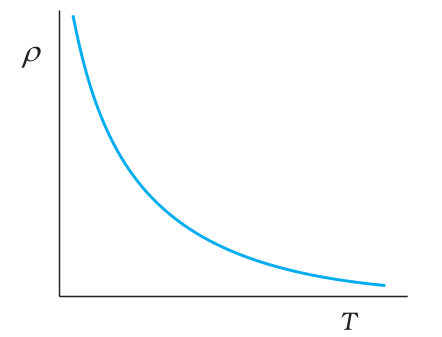
The correct answer is Option (4) → Resistivity of an intrinsic semiconductor decreases with increase of temperature.
Resistivity depends only on the material and its temperature, not on the size of the conductor.
Option (1) Ohm’s law is applicable to all materials. — Incorrect. It holds only for ohmic conductors; diodes and semiconductors do not obey it.
Option (2) Resistance of an incandescent lamp decreases when it is switched on. — Incorrect. The hot tungsten filament has a higher resistivity, so the resistance increases.
Option (3) Resistivity of a wire depends on its dimensions. — Incorrect. The resistance \( R = \rho l/A \) depends on the dimensions; the resistivity \( \rho \) does not.
Option (4) Resistivity of an intrinsic semiconductor decreases with increase of temperature. — Correct. Heating creates more electron–hole pairs; this rise in the number of carriers outweighs the extra collisions, so the resistivity falls.
NCERT (2026-27):
Temperature Dependence of Resistivity – “… Unlike metals, the resistivities of semiconductors decrease with increasing temperatures. A typical dependence is shown in Fig. 3.10. … For insulators and semiconductors, however, \( n \) increases with temperature. This increase more than compensates any decrease in \( \tau \) in Eq.(3.23) so that for such materials, \( \rho \) decreases with temperature.”