Passage
Chemical Kinetics
Some reactions such as ionic reactions occur very fast, for example, precipitation of silver chloride occurs instantaneously by mixing of aqueous solutions of silver nitrate and sodium chloride. On the other hand, some reactions are very slow, for example, rusting of iron in the presence of air and moisture. The sum of powers of the concentration of the reactants in the rate law expression is called the order of that chemical reaction. Another property of a reaction called molecularity helps in understanding its mechanism. The number of reacting species (atoms, ions or molecules) taking part in an elementary reaction, which must collide simultaneously in order to bring about a chemical reaction is called molecularity of a reaction. The half-life (t1/2) of a reaction is the time in which the concentration of a reactant is reduced to one-half of its initial concentration.
The order of reaction P (k = 2.3 × 10⁻⁵ mol L−1s−1) and Q (k = 4.1 × 10⁻⁵ L mol−1s−1) are respectively.
Answer & explanation
Correct answer: option 4
The correct answer is Option (4) → P = zero order reaction, Q = second order reaction
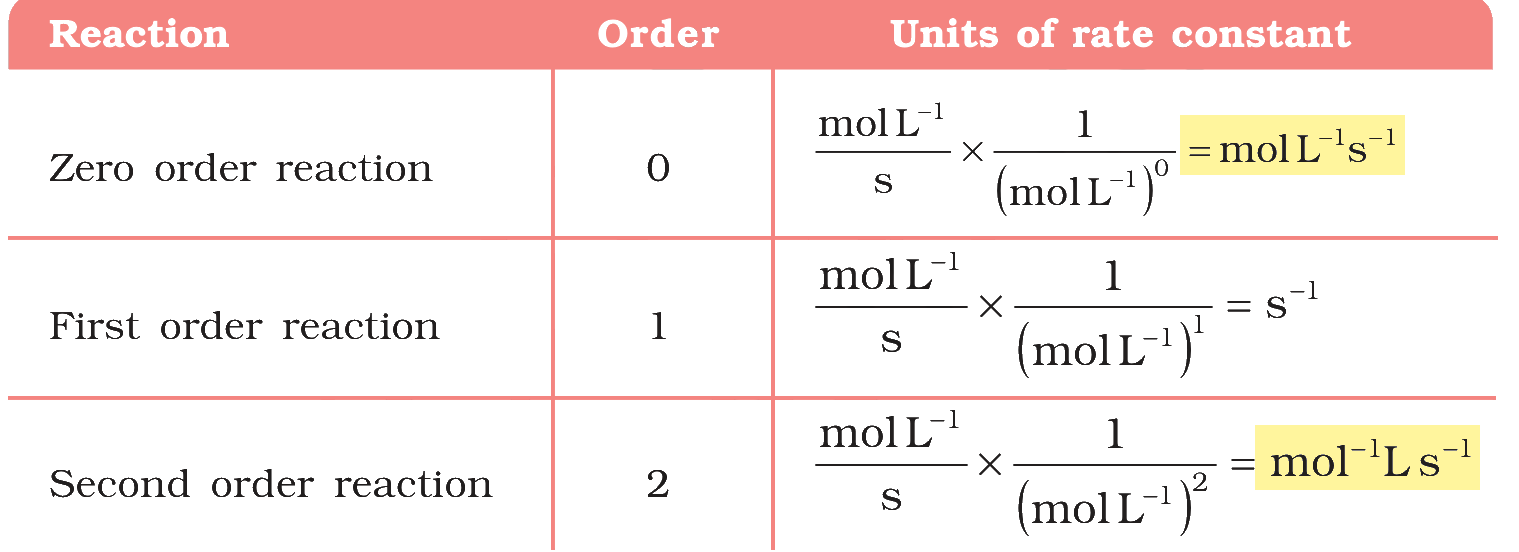
The rate of a reaction is the change in concentration per unit time, so its unit is always mol L−1 s−1. For a reaction of order n:
\( \displaystyle \text{Rate}=k[A]^n\quad\Rightarrow\quad k=\frac{\text{Rate}}{[A]^n} \)
\( \displaystyle \text{Unit of }k=\frac{\mathrm{mol\,L^{-1}\,s^{-1}}}{(\mathrm{mol\,L^{-1}})^n}=(\mathrm{mol\,L^{-1}})^{1-n}\,\mathrm{s^{-1}} \)
Only the unit of k tells the order; the numbers 2.3 × 10⁻⁵ and 4.1 × 10⁻⁵ play no part:
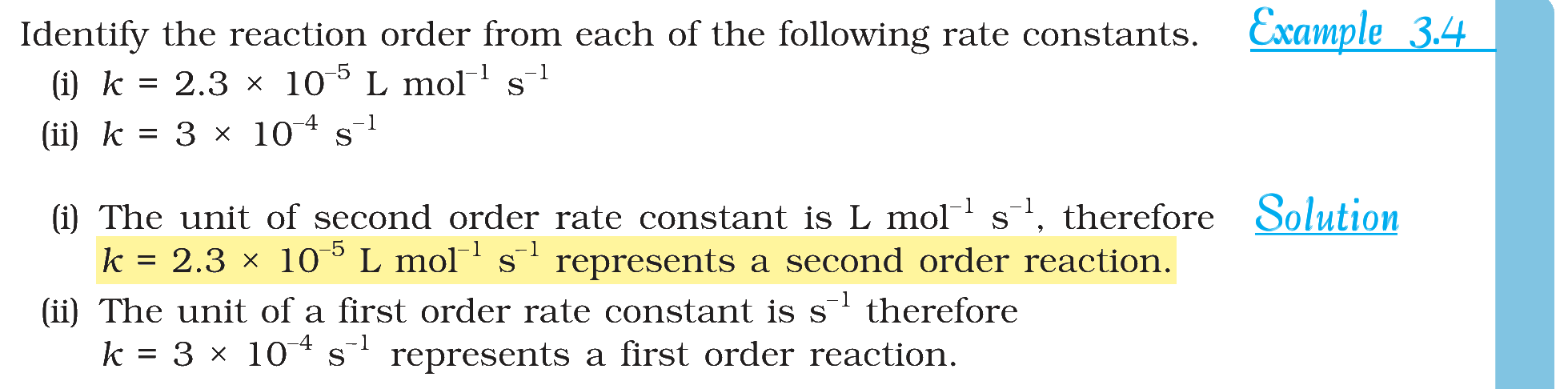
P has k in mol L−1 s−1, so it is a zero order reaction.
Q has k in L mol−1 s−1, so it is a second order reaction.
Shortcut: A first order k is always in s−1, and neither given unit is s−1. That rules out every option mentioning a first order reaction and leaves Option (4).
Note: NTA picked this question from an NCERT (2026-27) example and changed the figures. Do not ignore NCERT while practising numericals.
NCERT (2026-27 edition):
Units of Rate Constant – …