Which of the following statements are true in accordance with Nernst equation for the cell in which the following reaction takes place at 298K?
Ni(s) + 2Ag+ (aq)→ Ni2+(aq) + 2Ag(s).
E0(cell) is given 2.97 V and the concentration of Ag+ ion is 0.001 M and Ni2+ is 0.2 M.
Given: log 2 = 0.30
(A) Ecell = E0(cell) − RT/2F ln [Ni 2+] / [Ag+]2
(B) The electrode potential of the cell is 2.81V.
(C) Equilibrium constant Kc can be calculated from the given data.
(D) Ecell = E0(cell) − RT/2F ln [Ag+]2 / [Ni+]
Choose the correct answer from the options given below:
Answer & explanation
Correct answer: option 3
The correct answer is Option (3) → (A), (B) and (C) only
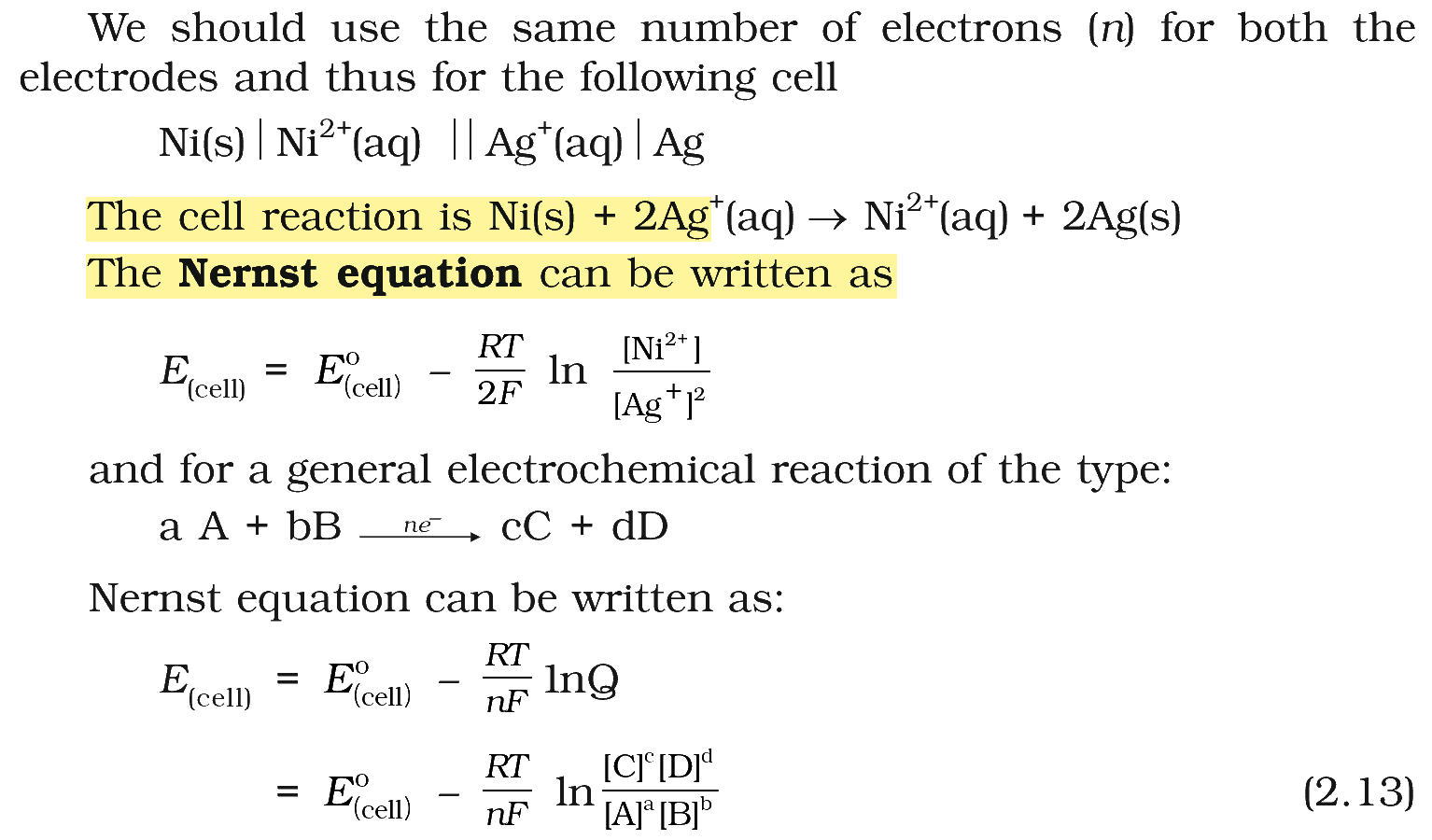
The Nernst equation relates the potential of a cell to the concentrations of the ions involved. For a cell reaction in which n electrons are transferred:
\( \displaystyle E_{cell}=E^{0}_{cell}-\frac{RT}{nF}\ln Q \)
\( \displaystyle E_{cell}=E^{0}_{cell}-\frac{0.059}{n}\log Q\quad (\text{at } 298\ \mathrm{K}) \)
Here Q is the reaction quotient: product ion concentrations divided by reactant ion concentrations. Pure solids are left out. At equilibrium, Ecell = 0 and Q becomes Kc:
\( \displaystyle E^{0}_{cell}=\frac{0.059}{n}\log K_c \)
In the given reaction, 2 electrons are transferred, so n = 2 and Q = \( \ce{[Ni^{2+}]} \)/[Ag+]2.
(A) Ecell = E0(cell) − RT/2F ln [Ni2+] / [Ag+]2 — Correct. This is the Nernst equation with n = 2 and the correct reaction quotient.
(B) The electrode potential of the cell is 2.81V. — Correct. \( \displaystyle E_{cell}=2.97-\frac{0.059}{2}\log\frac{0.2}{(10^{-3})^{2}} \)
\( \displaystyle =2.97-0.0295\log(2\times10^{5}) \)
\( \displaystyle =2.97-0.0295\times(0.30+5) \)
\( \displaystyle =2.97-0.156\approx2.81\ \mathrm{V} \)
(C) Equilibrium constant Kc can be calculated from the given data. — Correct. E0(cell) and n are both known, so Kc follows from the equilibrium form of the equation:
\( \displaystyle \log K_c=\frac{2\times2.97}{0.059} \)
(D) Ecell = E0(cell) − RT/2F ln [Ag+]2 / [Ni+] — Incorrect. The reaction quotient is inverted. The product ion (\( \ce{Ni^{2+}} \)) must be in the numerator and the reactant ion (\( \ce{Ag^{+}} \)) in the denominator.
Note: It seems that there is a mistake in the original NTA paper. In statement (D), the concentration term is printed as \( \ce{[Ni^{+}]} \); it should be \( \ce{[Ni^{2+}]} \), since the cell reaction forms \( \ce{Ni^{2+}} \) ions.
NCERT (2026-27 edition):
Nernst Equation – …