The major product formed by dehydrohalogenation of 2,2,3-trimethyl-3-bromopentane is
Answer & explanation
Correct answer: option 2
The correct answer is Option (2) → 3,4,4-trimethylpent-2-ene.
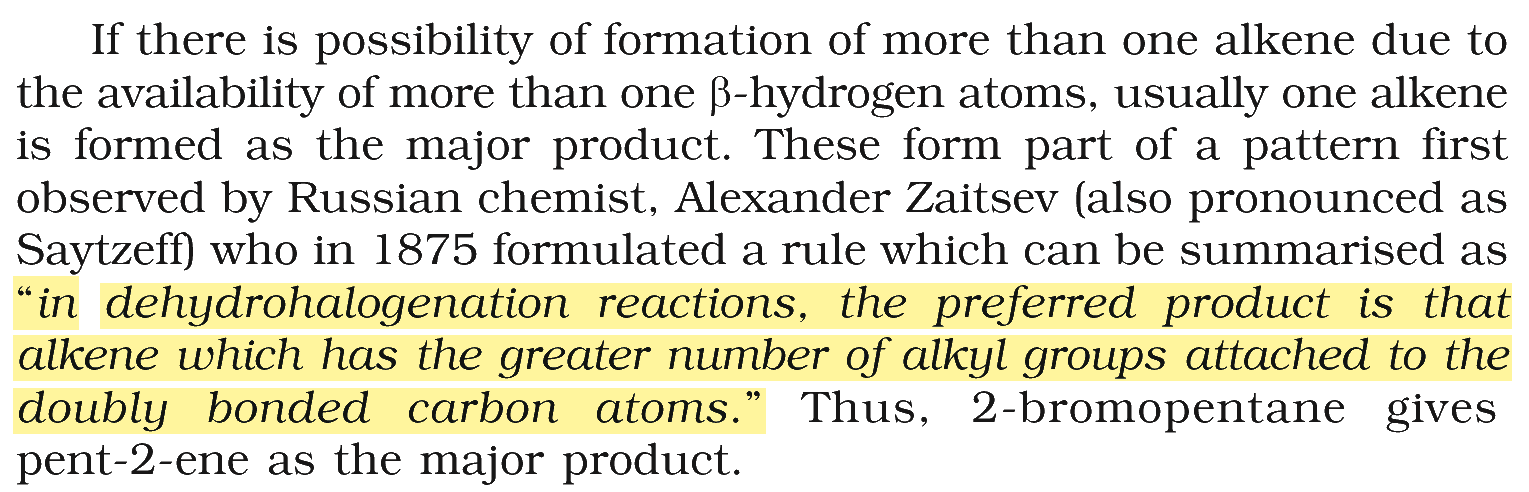
When a haloalkane is heated with alcoholic KOH, a hydrogen from a β-carbon and the halogen from the α-carbon are removed together, forming a C=C bond. If there is more than one kind of β-hydrogen, Saytzeff’s rule applies: the major product is the more substituted alkene, i.e. hydrogen is lost from the β-carbon that has fewer hydrogens.
The given compound (2,2,3-trimethyl-3-bromopentane) is:
\( \displaystyle \ce{CH3-C(CH3)2-C(Br)(CH3)-CH2-CH3} \)
The α-carbon (C3) has three neighbouring carbons:
C2, which carries no hydrogen, so no alkene can form towards it.
The methyl group on C3, whose loss of H gives a disubstituted alkene, \( \ce{CH2=C(C2H5)-C(CH3)3} \) (minor).
C4 (the \( \ce{CH2} \) group), whose loss of H gives a trisubstituted alkene (major).
\( \displaystyle \ce{CH3-C(CH3)2-C(Br)(CH3)-CH2-CH3 + KOH} \xrightarrow[\text{heat}]{\text{ethanol}} \underset{\text{3,4,4-trimethylpent-2-ene (major)}}{\ce{CH3-C(CH3)2-C(CH3)=CH-CH3}} + \ce{KBr + H2O} \)
Numbering the main chain from the end nearer the double bond places it at C2 and the methyl groups at C3, C4 and C4. So the major product is 3,4,4-trimethylpent-2-ene.
NCERT (2026-27 edition):
Elimination Reactions – …