
CUETMOCK
  • Pricing
  • Mentors
Log inStart freeStart free mocks→

First test, then trust

Try a free CUET mock test.

Join 5,00,000+ students who rehearsed exam day on the exact NTA screen before sitting CUET. On the web and on Android.

Start free mocks →Get the Android app
CUETMOCK

India's #1 CUET Mock Test Platform. Original NCERT-based questions on the exact NTA exam screen — trusted by 5,00,000+ students since CUET 2022.

Get it onGoogle PlayScan to download the CUETMOCK app

Mock tests

  • CUET mock test series
  • Commerce mocks
  • Humanities (Arts) mocks
  • Science mocks
  • Languages & GAT mocks
  • Free practice questions
  • Pricing

Resources

  • CUET exam guide
  • CUET syllabus
  • Universities accepting CUET
  • Expert blogs
  • News & notifications
  • Webinars & counselling
  • CUET score calculator
  • How we estimate your rank
  • FAQs

Company

  • About us
  • Our leadership & team
  • Our toppers
  • Mentors
  • For schools
  • Contact us
  • Terms
  • Privacy
  • Refund policy

Talk to us

+91 7696 6630 56info@cuetmock.comWhatsApp us

Our other platforms

  • JEE Mock — For IIT-JEE aspirants
  • NEET Mock — For NEET aspirants

Newsletter

Exam updates, study material and offers — no spam.

© 2026 NYC Ventures Pvt. Ltd.

701-702, Royal Business Park, Zirakpur, Punjab - 140603

  • Terms of use
  • Privacy policy
  • Refund policy
  • Contact us

iCUETMOCK is an independent preparation platform, not affiliated with the National Testing Agency (NTA). Always check exam details on the official NTA website.

  • Home
  • Mock tests
  • CUET guide
  • Pricing
  • Log in
Home/Practice questions/Chemistry
ChemistryOrganic: Aldehydes, Ketones and Carboxylic Acids

Identify the catalyst used in Rosenmund reduction.

Organic synthesis and applications

In aldehydes, carbonyl group is bonded to carbon and hydrogen while in ketones, it is bonded to two carbon atoms. The carbonyl carbon atom is sp2-hybridised and a trigonal coplanar structure. The bond angles are approximately 120°. Methanal is gas at room temperature. Ethanal is a volatile liquid. Other aldehydes and ketones are liquid or solid at room temperature. The boiling points of aldehydes and ketones are higher than hydrocarbons and ether of comparable molecular masses. It is due to weak molecular association in aldehydes and ketones arising out of the dipole-dipole interactions. Their boiling points are lower than those of alcohols of similar molecular masses due to absence of intermolecular hydrogen bonding. The lower members of aldehydes and ketones are miscible with water because they form hydrogen bonding with water. However, the solubility of aldehydes and ketones decreases rapidly on increasing the length of alkyl chain.

Aldehydes are generally more reactive than ketones in the nucleophilic addition reactions due to steric and electronic reasons. An organic compound (A) with molecular formula C8H8O forms an orange-red precipitate with 2,4-DNP reagent and gives yellow precipitate on heating with iodine in the presence of sodium hydroxide. It neither reduces Tollens' or Fehling's reagent, nor does it decolourise bromine water or Baeyer's reagent. On drastic oxidation with chromic acid, it gives a carboxylic acid (B) having molecular formula C7H6O2.

Identify the catalyst used in Rosenmund reduction.

Answer & explanation+

Correct answer: option 4

The correct answer is Option (4) → Pd-BaSO4

Aldehydes are prepared by several named reactions, each with its own starting material and reagent:

  • Rosenmund reduction: an acyl chloride is hydrogenated over palladium on barium sulphate.

  • Stephen reaction: a nitrile is reduced by SnCl2/HCl to an imine, which is hydrolysed to an aldehyde.

  • Etard reaction: toluene is oxidised by chromyl chloride (\( \ce{CrO2Cl2} \)) to a chromium complex, which is hydrolysed to benzaldehyde.

  • Gattermann–Koch reaction: benzene is treated with CO and HCl in the presence of anhydrous AlCl3 or CuCl to give benzaldehyde.

In the Rosenmund reduction the catalyst is Pd on BaSO4. \( \ce{BaSO4} \) (often with a little sulphur or quinoline) poisons the palladium, so that the aldehyde is not reduced further to an alcohol:

    \( \displaystyle \ce{R-COCl + H2} \xrightarrow{\ce{Pd}-\ce{BaSO4}} \ce{R-CHO + HCl} \)

So the catalyst used in Rosenmund reduction is Pd-BaSO4.

Why the other options are incorrect

  • Option (1) AlCl3/CuCl — Incorrect. This is the catalyst of the Gattermann–Koch reaction.

        \( \displaystyle \ce{C6H6 + CO + HCl} \xrightarrow{\text{anhyd. }\ce{AlCl3}/\ce{CuCl}} \ce{C6H5CHO} \)

  • Option (2) CrO2Cl2 — Incorrect. Chromyl chloride is the reagent of the Etard reaction.

        \( \displaystyle \ce{C6H5CH3} \xrightarrow[\text{(ii) }\ce{H3O+}]{\text{(i) }\ce{CrO2Cl2},\ \ce{CS2}} \ce{C6H5CHO} \)

  • Option (3) SnCl2/HCl — Incorrect. This is the reducing agent of the Stephen reaction.

        \( \displaystyle \ce{R-CN} \xrightarrow[\text{(ii) }\ce{H3O+}]{\text{(i) }\ce{SnCl2}/\ce{HCl}} \ce{R-CHO} \)

NCERT (2026-27 edition):
From Acyl Chloride (Acid Chloride)
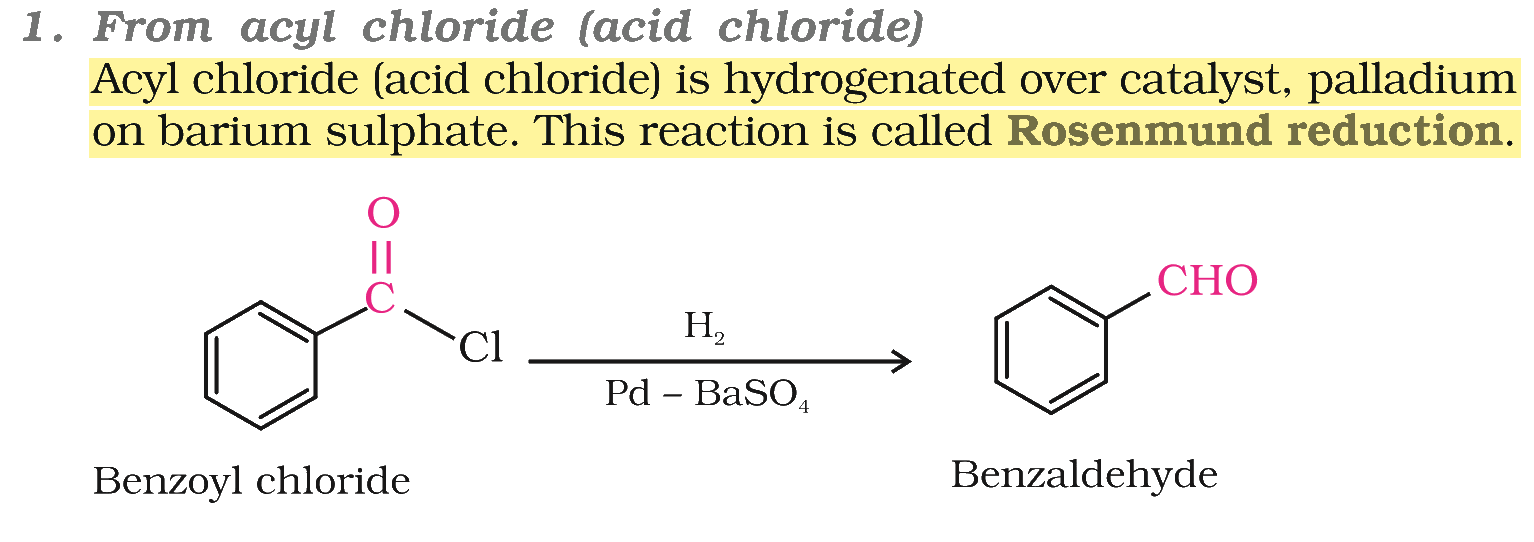
Textbook extract

Advertisement

Practise more on Organic: Aldehydes, Ketones and Carboxylic Acids

Chapter-wise mocks on the real NTA exam screen, with solutions and your rank. Your first mocks are free.

Start free mocks →

Advertisement

Next questions

  1. Which of the following are the types of innate immunity barriers?(A) Physical barriers(B) Cellular barriers(C) Cytokine barriers(D) Humoral…Biology · Human Health and Disease
  2. ‘Population Doubling time’ means:Geography · India-People and Economy: Population-Distribution,Density, Growth and Composition
  3. Match List-I with List-IIList-ITypes of complexesList-IIIsomerisms(A) [Co(NH3)4Cl2]+(I) Coordination(B) [Co(en)3]3+(II) Linkage(C) [Co(NH3)…Chemistry · Inorganic: Coordination Compounds
  4. A shopkeeper sells a mobile phone for Rs. 8107 and makes a profit of 21%. Find the cost of the mobile phone.General Aptitude Test · Numerical Ability
  5. The products of complete hydrolysis of DNA are(A) phosphoric acid.(B) N-containing heterocyclic compound.(C) nitrogen gas(D) pentose sugar.…Chemistry · Organic: Biomolecules
  6. Due to non-payment of call money, a company has forfeited shares which were issued at premium earlier and the premium amount has been recei…Accountancy Part A · Accounting for Shares
  7. If the radius of the electron orbit for n = 3 for a hydrogen atom is 4.5\ mathringA . The radius for n = 2 orbit isPhysics · Atoms
  8. A galvanic cell has electrical potential 1.1V, on applying external potential greater than 1.1 V the cell willChemistry · Physical: Electro Chemistry
  9. Four numbers are given out of which three are alike in some manner while one is different. Choose the combination which follows the same pa…General Aptitude Test · Verbal Reasoning
  10. Which of the following has revolutionised the urban transport system in India?Geography · India-People and Economy: Transport and Communcation