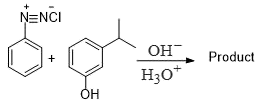
Identify the product formed in the reaction;
Answer & explanation
Correct answer: option 3
The correct answer is Option (3) → 4-(phenylazo)-3-isopropylphenol (structure 3)
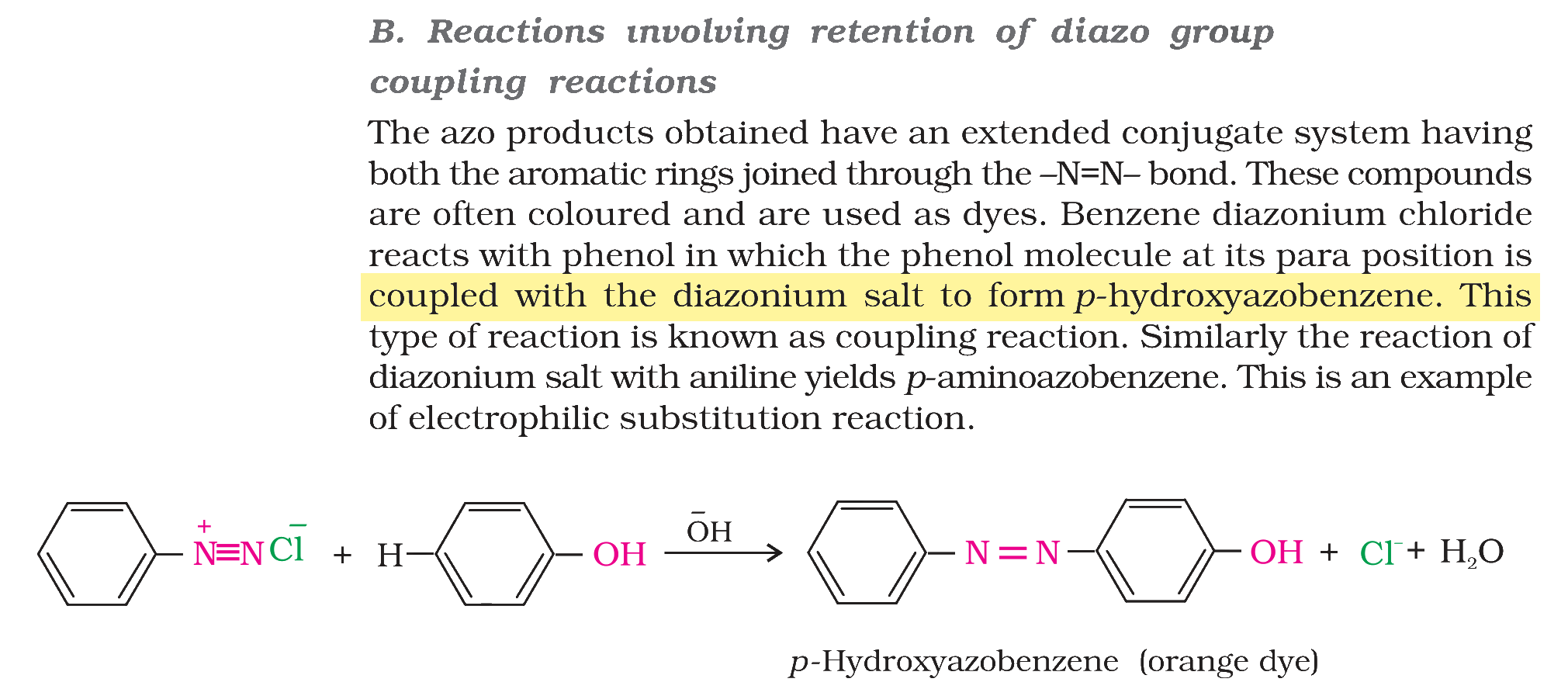
Benzenediazonium chloride reacts with phenols in a mildly alkaline medium to form brightly coloured azo compounds (coupling reaction). The diazonium ion is a weak electrophile, so it attacks only a strongly activated ring. In alkali, the phenol becomes the phenoxide ion, whose –\( \ce{O^{-}} \) group strongly activates the ortho and para positions. Coupling takes place mainly at the para position to –OH; acidifying afterwards (\( \ce{H3O^{+}} \)) converts –\( \ce{O^{-}} \) back to –OH:
\( \displaystyle \ce{C6H5N2^+Cl^- + C6H5OH} \xrightarrow{\ce{OH^-}} \ce{HO-C6H4-N=N-C6H5 + Cl^- + H2O} \quad \text{(para product)} \)
The phenol in the scheme carries an isopropyl group meta to –OH (3-isopropylphenol). The position para to –OH is free (it lies next to the isopropyl group), so the –\( \ce{N=N-C6H5} \) group enters there. In the product, the –OH is para to the azo group and the isopropyl group is ortho to it, while the ring from the diazonium salt stays unsubstituted. This is structure 3:
\( \displaystyle \ce{C6H5N2^+Cl^-} + \text{3-isopropylphenol} \xrightarrow{\ce{OH^-}} \text{4-(phenylazo)-3-isopropylphenol} + \ce{Cl^- + H2O} \)
Why the other options are incorrect
Option (1) structure 1 — Incorrect. The isopropyl group is shown on the ring that came from the diazonium salt, which carried no substituent.
Option (2) structure 2 — Incorrect. The isopropyl group is again on the wrong ring, and the –OH is meta to the azo group.
Option (4) structure 4 — Incorrect. The –OH is meta to the azo group; coupling occurs para to the –OH group.
NCERT (2026-27 edition):
Reactions Involving Retention of Diazo Group