
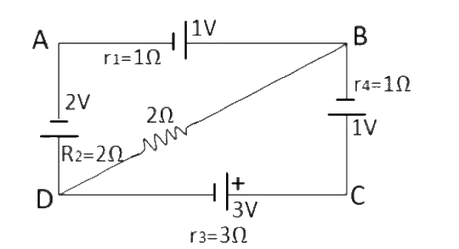
In the given electric circuit four cells of emf 1 V, 2 V, 3 V, 1 V, and internal resistances 1 Ω, 2 Ω, 3 Ω, 1 Ω, respectively, are connected. The current through resistance of 2 Ω connected between the two diagonal points (B and D) is:
Answer & explanation
Correct answer: option 4
The correct answer is Option (4) → (1/13) A
Use Kirchhoff’s rules. B and D are the only junctions, and three branches join them: D–A–B, D–C–B and the 2 Ω diagonal. In the figure the longer plate of each cell is its positive terminal.
Take the potential of D as zero and let the potential of B be V. Going from D to B along each branch, an emf counts as positive when the cell is crossed from its negative to its positive terminal.
\( \text{D-A-B: } -2\,\mathrm{V} + 1\,\mathrm{V} = -1\,\mathrm{V}, \text{ resistance } 2 + 1 = 3\,\Omega \)
\( \text{D-C-B: } +3\,\mathrm{V} - 1\,\mathrm{V} = +2\,\mathrm{V}, \text{ resistance } 3 + 1 = 4\,\Omega \)
\( \text{D-B: no cell, resistance } 2\,\Omega \)
The current from D to B in each branch is (net emf − V) ÷ resistance, and by the junction rule these currents add up to zero at B.
\( \displaystyle \frac{-1 - V}{3} + \frac{2 - V}{4} + \frac{0 - V}{2} = 0 \)
Multiplying by 12:
\( -4 - 4V + 6 - 3V - 6V = 0 \)
\( 13V = 2 \)
\( \displaystyle V = \frac{2}{13}\,\mathrm{V} \)
\( \displaystyle I_{BD} = \frac{V}{2} = \frac{1}{13}\,\mathrm{A} \)
The current in the diagonal flows from B to D.