CUETMOCK
  • Pricing
  • Mentors
Log inStart freeStart free mocks→

First test, then trust

Try a free CUET mock test.

Join 5,00,000+ students who rehearsed exam day on the exact NTA screen before sitting CUET. On the web and on Android.

Start free mocks →Get the Android app
CUETMOCK

India's #1 CUET Mock Test Platform. Original NCERT-based questions on the exact NTA exam screen — trusted by 5,00,000+ students since CUET 2022.

Get it onGoogle PlayScan to download the CUETMOCK app

Mock tests

  • CUET mock test series
  • Commerce mocks
  • Humanities (Arts) mocks
  • Science mocks
  • Languages & GAT mocks
  • Free practice questions
  • Pricing

Resources

  • CUET exam guide
  • CUET syllabus
  • Universities accepting CUET
  • Expert blogs
  • News & notifications
  • Webinars & counselling
  • CUET score calculator
  • How we estimate your rank
  • FAQs

Company

  • About us
  • Our leadership & team
  • Our toppers
  • Mentors
  • For schools
  • Contact us
  • Terms
  • Privacy
  • Refund policy

Talk to us

+91 7696 6630 56info@cuetmock.comWhatsApp us

Our other platforms

  • JEE Mock — For IIT-JEE aspirants
  • NEET Mock — For NEET aspirants

Newsletter

Exam updates, study material and offers — no spam.

© 2026 NYC Ventures Pvt. Ltd.

701-702, Royal Business Park, Zirakpur, Punjab - 140603

  • Terms of use
  • Privacy policy
  • Refund policy
  • Contact us

iCUETMOCK is an independent preparation platform, not affiliated with the National Testing Agency (NTA). Always check exam details on the official NTA website.

  • Home
  • Mock tests
  • CUET guide
  • Pricing
  • Log in
Home/Practice questions/Geography
GeographyFundamentals of Human Geography: World Population-Distribution, Density and growth

Match the LIST-I with LIST-IILIST-I(Stage of Demographic Transition T…

Match the LIST-I with LIST-II

LIST-I
(Stage of Demographic Transition Theory)
LIST-II
(Country)
A.High FluctuatingI.Canada
B.Early ExpandingII.Afghanistan
C.Late ExpandingIII.India
D.Low FluctuatingIV.Rainforest Tribe

Choose the correct answer from the options given below:

Answer & explanation+

Correct answer: option 2

The correct answer is Option (2) → A-IV, B-II, C-III, D-I

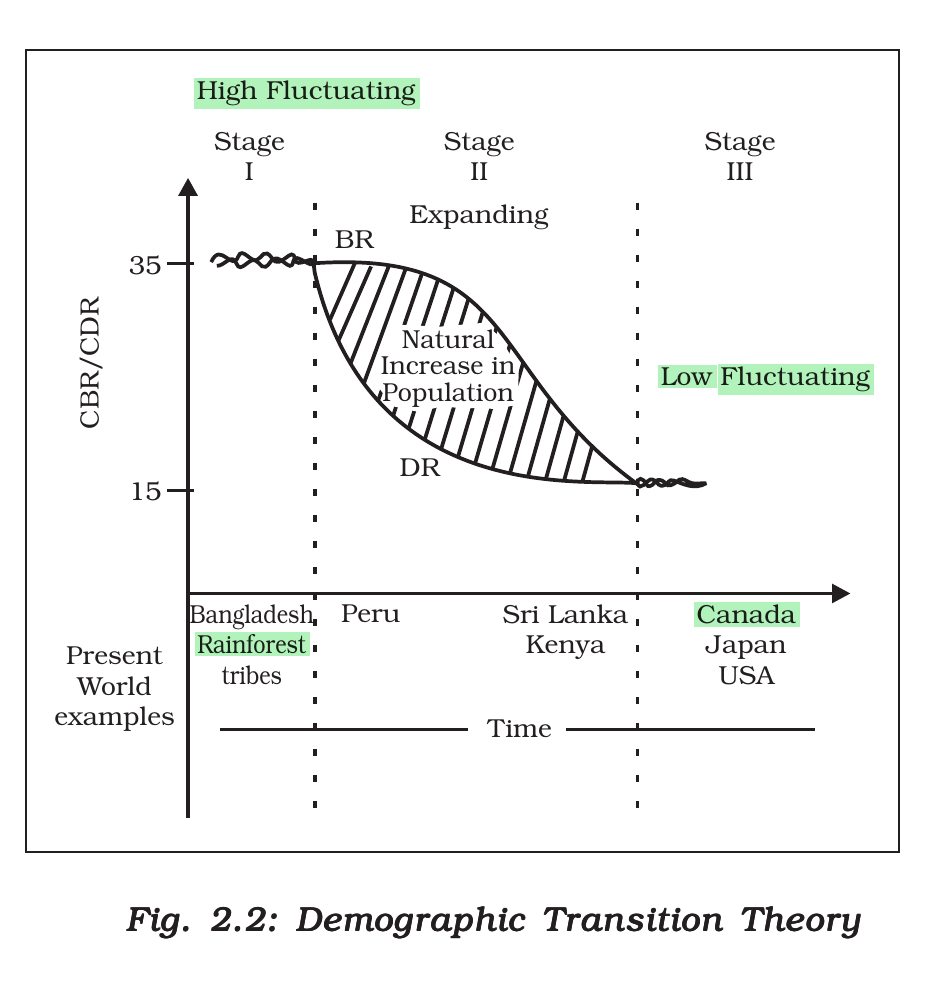
(A) High Fluctuating — this matches (IV) Rainforest Tribe. In the first stage both fertility and mortality are high, so the population grows slowly; the diagram gives rainforest tribes as a present-day example.

(B) Early Expanding — this matches (II) Afghanistan. At the start of the second stage fertility is still high while mortality falls, so the population expands fast. Afghanistan is not placed on the diagram (see the Note).

(C) Late Expanding — this matches (III) India. Later in the second stage fertility also begins to decline. India’s population growth since 1981 has been slowing down gradually because the birth rate is falling, which is this late part of the expanding stage.

(D) Low Fluctuating — this matches (I) Canada. In the last stage both fertility and mortality are low, and the population is stable or grows slowly; the diagram gives Canada with Japan and the USA.

Note: The diagram of demographic transition in the current NCERT book (2025-26) gives rainforest tribes for the first stage and Canada for the last stage, but it names neither Afghanistan nor India, and Afghanistan is not mentioned in the book. India’s stage follows from the book’s account of its falling birth rate since 1981. The two items on the diagram, (A) and (D), already decide the answer: Option (2) is the only option with both A-IV and D-I.


NCERT (2025-26): “Demographic Transition … Fig. 2.2 explains the three-staged model of Demographic Transition Theory: The first stage has high fertility and high mortality because people reproduce more to compensate for the deaths due to epidemics and variable food supply. The population growth is slow and most of the people are engaged in agriculture where large families are an asset. Life expectancy is low, people are mostly illiterate and have low levels of technology. Two hundred years ago all the countries of the world were in this stage.”

“Demographic Transition … Fertility remains high in the beginning of second stage but it declines with time. This is accompanied by reduced mortality rate. Improvements in sanitation and health conditions lead to decline in mortality. Because of this gap the net addition to population is high.…”

“Demographic Transition … In the last stage, both fertility and mortality decline considerably. The population is either stable or grows slowly. The population becomes urbanised, literate and has high technical know- how and deliberately controls the family size.…”

“Growth of Population … Phase IV : In the post 1981 till present, the growth rate of country’s population though remained high, has started slowing down gradually …. A downward trend of crude birth rate is held responsible for such a population growth. This was, in turn, affected by an increase in the mean age at marriage, improved quality of life particularly education of females in the country.”

NCERT extract

Advertisement

Practise more on Fundamentals of Human Geography: World Population-Distribution, Density and growth

Chapter-wise mocks on the real NTA exam screen, with solutions and your rank. Your first mocks are free.

Start free mocks →

Advertisement

Next questions

  1. Match the LIST-I with LIST-IILIST-ILIST-IIA.Increase in the value of each asset will be shownI.it indicates net gain, which will be transfe…Accountancy Part A · Admission of a Partner
  2. Match List-I with List-II:List-IList-IICauses of biodiversity lossExamples(A) Habitat loss and fragmentation(I) Nile perch in Victoria Lake…Biology · Biodiversity and Conservation
  3. The most dense rail network is found in East Central U.S.A. and adjoining Canada because:Geography · Fundamentals of Human Geography: Transport and Communication
  4. Which of the following statement is incorrect about heat?General Aptitude Test · General Knowledge
  5. For the function f(x)=|x-1|+|x-2|+|x-3| Match the LIST-I with LIST-IILIST-ILIST-IIFunction f(x) =For IntervalA. -3x+6 I. x≥ 3 B. -x+4 II. x…Applied Maths. Section A · Relations and Functions
  6. Which of the following are examples of common property resources?A. Community forestsB. Pasture landsC. Village water bodiesD. Private scho…Geography · India-People and Economy: Land resources and Agriculture
  7. In the linear programming problem maximize z=4x+3y subject to the constraints x+y≥ 8 , 3x+5y≤ 15,\ x≥ 0,y≥ 0 , the feasible region hasApplied Maths. Section A · Linear Programming (Section A)
  8. Match the LIST-I with LIST-II.LIST-I(Complex ions)LIST-II(Magnetic Moment)(A) [Fe(H2O)6]2+(I) 2.84 BM(B) [Mn(H2O)6]2+(II) 3.87 BM(C) [Ni(H2…Chemistry · Inorganic: Coordination Compounds
  9. Match List-I with List-IIList-IList-II(A)Nominal rate of return(I) EMI=(Principal+Interest)/(Period\ in\ months) (B)CAGR(II) (Original\ val…Applied Maths. Section B2 · Financial Mathematics
  10. Mr. X runs 5 times as fast as Mr. Y. If Mr. X gives Mr. Y a start of 80 meters, how far must the goal on the race course be so that Mr. X a…Applied Maths. Section B2 · Numbers, Quantification and Numerical Applications