
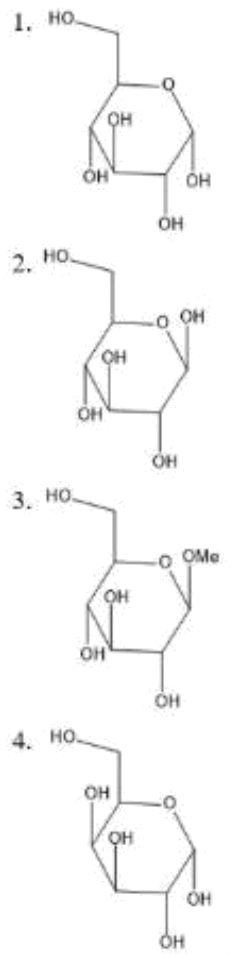
Which of the following sugar is a non-reducing sugar?
Answer & explanation
Correct answer: option 3
The correct answer is Option (3) → 3
A reducing sugar reduces Fehling’s solution and Tollens’ reagent. It can do so because its ring can open to a free aldehyde (or ketone) group. This is possible only when the anomeric carbon (C1) carries a free –OH group (a hemiacetal): the ring is then in equilibrium with the open chain.
If the anomeric –OH is converted into an –OR group (a glycoside, i.e. an acetal), the ring can no longer open, no free –CHO is available, and the sugar becomes non-reducing. This is why sucrose, in which both anomeric carbons are tied up in the glycosidic bond, is non-reducing.
Structures 1, 2 and 4: the anomeric carbon (next to the ring oxygen) carries a free –OH, so they are hemiacetals and are reducing.
Structure 3: the anomeric carbon carries –OMe. It is a methyl glycoside (methyl glucopyranoside), so it is non-reducing.
NCERT (2026-27 edition):
Disaccharides – “… In disaccharides, if the reducing groups of monosaccharides i.e., aldehydic or ketonic groups are bonded, these are non-reducing sugars, e.g., sucrose. On the other hand, sugars in which these functional groups are free, are called reducing sugars, for example, maltose and lactose.”