CUETMOCK
  • Pricing
  • Mentors
Log inStart freeStart free mocks→

First test, then trust

Try a free CUET mock test.

Join 5,00,000+ students who rehearsed exam day on the exact NTA screen before sitting CUET. On the web and on Android.

Start free mocks →Get the Android app
CUETMOCK

India's #1 CUET Mock Test Platform. Original NCERT-based questions on the exact NTA exam screen — trusted by 5,00,000+ students since CUET 2022.

Get it onGoogle PlayScan to download the CUETMOCK app

Mock tests

  • CUET mock test series
  • Browse all papers
  • Commerce mocks
  • Humanities (Arts) mocks
  • Science mocks
  • Languages & GAT mocks
  • Free practice questions
  • Pricing

Resources

  • CUET exam guide
  • CUET syllabus
  • Universities accepting CUET
  • Expert blogs
  • News & notifications
  • Webinars & counselling
  • CUET score calculator
  • How we estimate your rank
  • FAQs

Company

  • About us
  • Our leadership & team
  • Our toppers
  • Mentors
  • For schools
  • Contact us
  • Terms
  • Privacy
  • Refund policy

Talk to us

+91 7696 6630 56info@cuetmock.comWhatsApp us

Our other platforms

  • JEE Mock — For IIT-JEE aspirants
  • NEET Mock — For NEET aspirants

Newsletter

Exam updates, study material and offers — no spam.

© 2026 NYC Ventures Pvt. Ltd.

701-702, Royal Business Park, Zirakpur, Punjab - 140603

  • Terms of use
  • Privacy policy
  • Refund policy
  • Contact us

iCUETMOCK is an independent preparation platform, not affiliated with the National Testing Agency (NTA). Always check exam details on the official NTA website.

  • Home
  • Mock tests
  • CUET guide
  • Pricing
  • Log in
Home/Practice questions/History
HistoryAncient India: Thinkers, Beliefs and Buildings

Which of the following is correctly matched:

Read the passage and answer the questions:

Buddhism

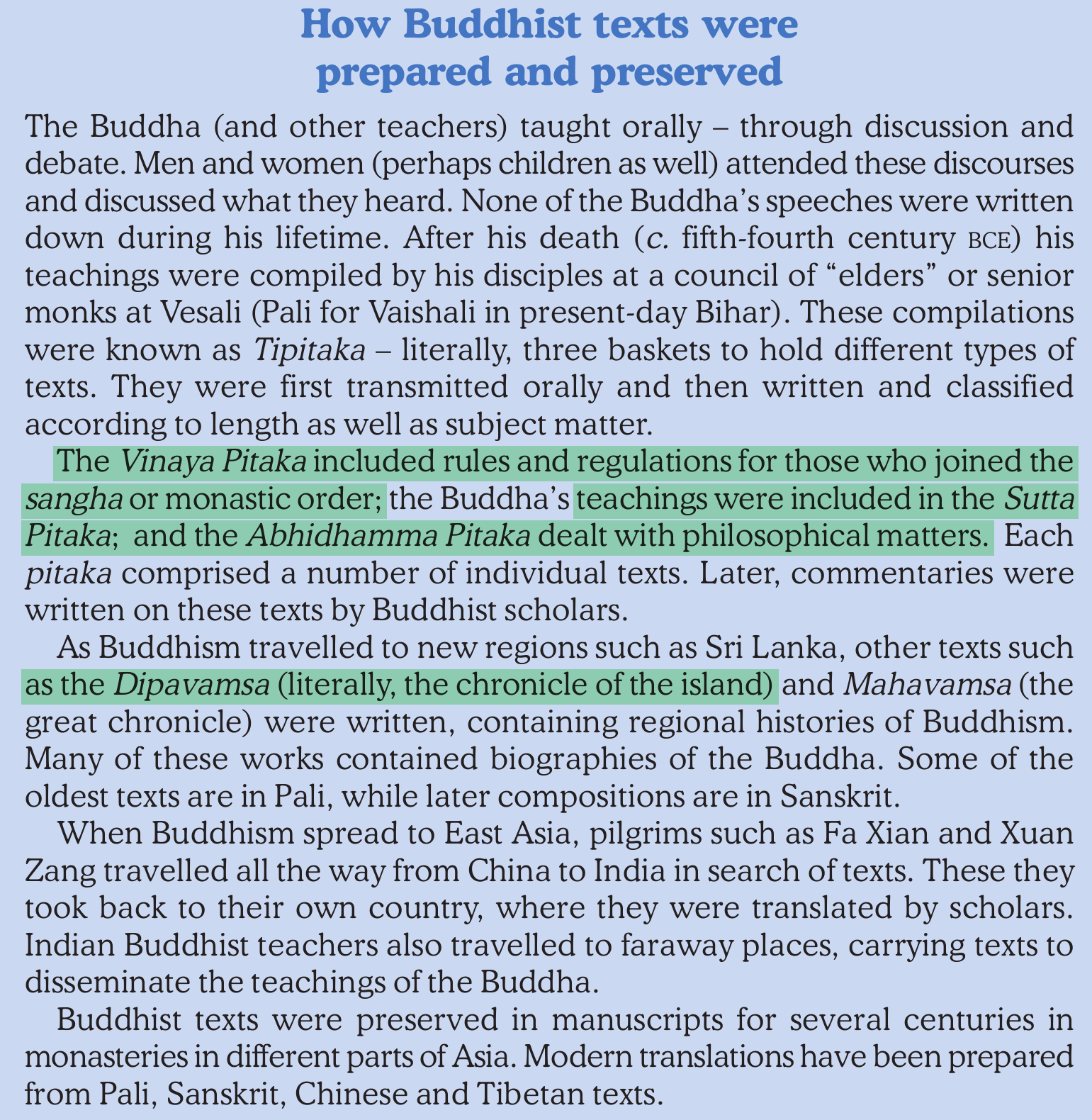
The Buddha (and other teachers) taught orally—through discussion and debate. Men and women (perhaps children as well) attended these discourses and discussed what they heard. None of the Buddha’s speeches were written down during his lifetime. After his death (c. fifth–fourth century BCE), his teachings were compiled by his disciples at a council of “elders” or senior monks at Vesāli (Pali for Vaishali in present-day Bihar). These compilations were known as the Tipitaka—literally, three baskets to hold different types of texts. They were first transmitted orally and then written and classified according to length as well as subject matter. The Vinaya Pitaka included rules and regulations for those who joined the sangha or monastic order; the Buddha’s teachings were included in the Sutta Pitaka; and the Abhidhamma Pitaka dealt with philosophical matters. Each pitaka comprised a number of individual texts. Later, commentaries were written on these texts by Buddhist scholars. As Buddhism traveled to new regions such as Sri Lanka, other texts such as the Dipavamsa (literally, the chronicle of the island) and Mahavamsa (the great chronicle) were written. Many of these works contained biographies of the Buddha. Some of the oldest texts are in Pali, while later compositions are in Sanskrit. When Buddhism spread to East Asia, pilgrims such as Fa Xian and Xuan Zang traveled all the way from China to India in search of texts. These they took back to their own country, where they were translated by scholars. Indian Buddhist teachers also traveled to faraway places, carrying texts to disseminate the teachings of the Buddha. Buddhist texts were preserved in manuscripts for several centuries in monasteries in different parts of Asia. Modern translations have been prepared from Pali, Sanskrit, Chinese, and Tibetan texts.

Which of the following is correctly matched:

Answer & explanation+

Correct answer: option 2

The correct answer is Option (2) → Dipavamsa - Chronicle of the island

Option (1) Abhidhamma Pitaka - Buddha’s teachings — Incorrect. The Abhidhamma Pitaka dealt with philosophical matters. The Buddha’s teachings are in the Sutta Pitaka.

Option (2) Dipavamsa - Chronicle of the island — Correct. The name Dipavamsa literally means “the chronicle of the island”. It was written in Sri Lanka as Buddhism travelled there.

Option (3) Sutta Piṭaka - Rules and regulations of the ‘sangha’ — Incorrect. The Sutta Pitaka contained the Buddha’s teachings. The rules and regulations for those who joined the sangha are in the Vinaya Pitaka.

Option (4) Vinaya Pitaka - Philosophical matters — Incorrect. The Vinaya Pitaka included rules and regulations for those who joined the sangha, the monastic order. Philosophical matters are in the Abhidhamma Pitaka.


NCERT: Themes in Indian History Part I — Chapter 4: Thinkers, Beliefs and Buildings (2025-26)

NCERT extract

Advertisement

Practise more on Ancient India: Thinkers, Beliefs and Buildings

Chapter-wise mocks on the real NTA exam screen, with solutions and your rank. Your first mocks are free.

Start free mocks →

Advertisement

Next questions

  1. Rearrange the following parts of a sentence to form a meaningful sentence:A. across time through the tales of those around him,B. of physic…English · Arrange in Meaningful Sequence
  2. Which work describes the irrigation devices in northern India?History · Medieval India: Peasants, Zamindars and the State
  3. Arrange the following in chronological order (oldest to latest)(A) The Tata Iron and Steel Company (TISCO).(B) Introduction of railways in…Economics · Indian Economic Development: Indian Economy on the Eve of Independence
  4. Match List-I with List-II:List-IAssociative-TermsList-IITitles(A) Deccan Sultans(I) Ashvapati(B) Vijayanagara ‘Raya’(II) Narapati(C) Ruling…History · Medieval India: An Imperial Capital: Vijayanagara
  5. Choose the appropriate word which is opposite in meaning to the underlined word.The benevolent king showed clemency to the defeated soldier.English · Antonyms
  6. Which one of the following is correct about Sino-Indian relations since 1962?Political Science · Politics in India Since Independence: India's External Relations
  7. Propionitrile when treated with phenyl magnesium bromide followed by acidic hydrolysis gives (P) which further undergoes Clemmensen reducti…Chemistry · Organic: Aldehydes, Ketones and Carboxylic Acids
  8. The solution of the differential equation displaystyledy/dx=(x+2)/(3-y),(y≠ 3),y(0)=0 representsMaths. Section A · Differential Equations
  9. Interferons can be defined as -Biology · Human Health and Disease
  10. Phenol, upon treatment with concentrated sulfuric acid, yields a compound (X), which upon reaction with concentrated nitric acid forms (Z).…Chemistry · Organic: Alcohols, Phenols and Ethers