Ammonolysis of alkyl halides is commonly used to prepare primary, secondary, and tertiary amines. Choose the correct statements .
(A) The order of reactivity of halides with amines is RI < RBr < RCl
(B) Primary amine is obtained as the major product if ammonia is taken in large excess.
(C) The amino group replaces the halogen atom by nucleophilic substitution reaction.
(D) It is a preferred method as it yields a mixture of primary, secondary and tertiary amines.
Choose the correct answer from the options given below:
Answer & explanation
Correct answer: option 3
The correct answer is Option (3) → (B) and (C) only
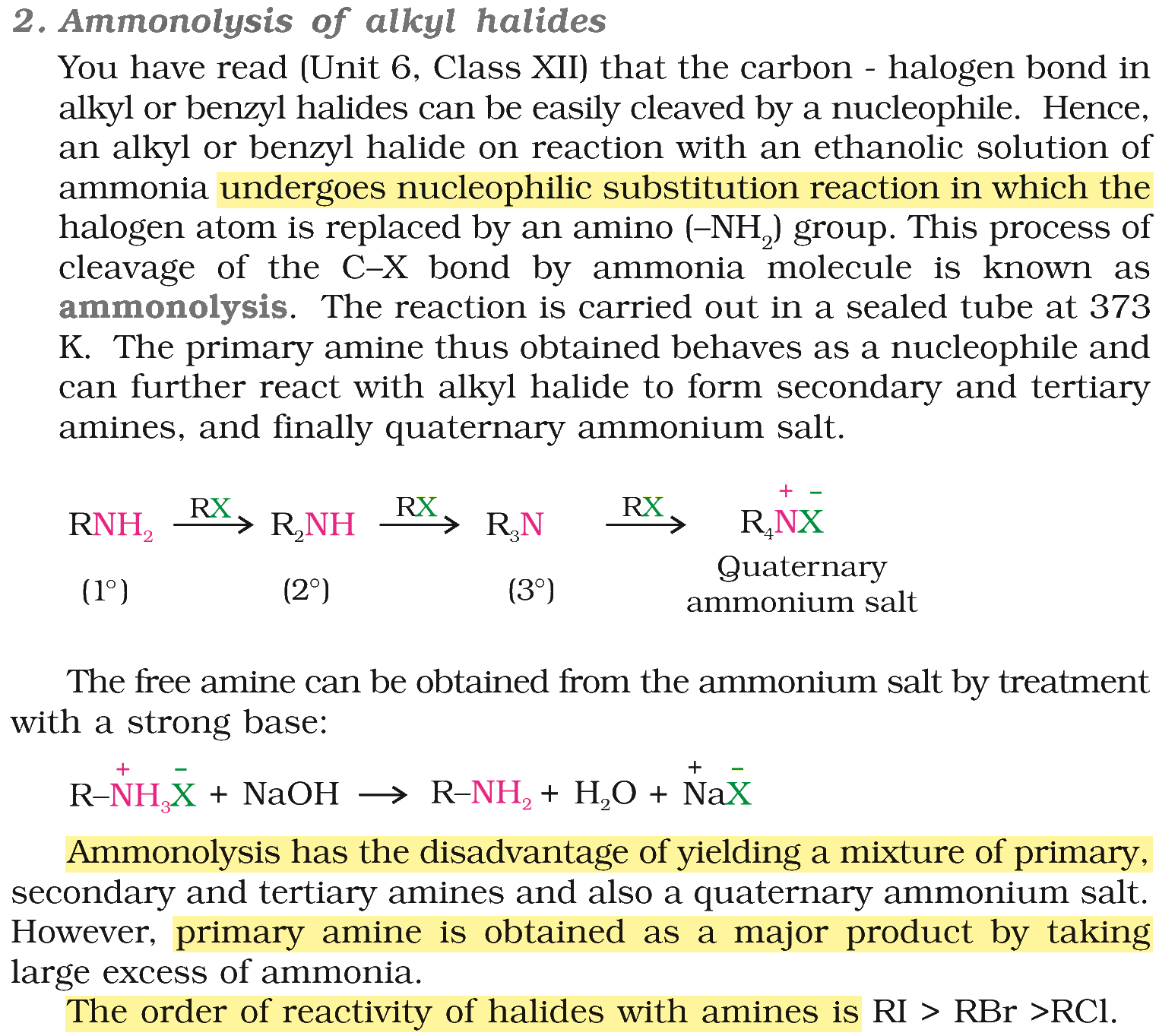
In ammonolysis, an alkyl halide is heated with an ethanolic solution of ammonia in a sealed tube. Ammonia is a nucleophile and replaces the halogen:
\( \displaystyle \ce{R-X + NH3} \xrightarrow[\text{sealed tube, 373 K}]{\text{ethanolic}} \ce{R-NH3^+X^-} \)
\( \displaystyle \ce{R-NH3^+X^- + NaOH -> R-NH2 + H2O + NaX} \)
The primary amine formed is also a nucleophile and reacts with more alkyl halide, giving secondary and tertiary amines and finally a quaternary ammonium salt.
(A) The order of reactivity of halides with amines is RI < RBr < RCl Incorrect. The order is reversed: RI > RBr > RCl. The C–I bond is the weakest, so iodide leaves most easily.
(B) Primary amine is obtained as the major product if ammonia is taken in large excess. Correct. With a large excess of ammonia, an alkyl halide molecule is far more likely to meet ammonia than the amine already formed, so the primary amine is the main product.
(C) The amino group replaces the halogen atom by nucleophilic substitution reaction. Correct. The lone pair of nitrogen attacks the carbon bonded to the halogen, and the halide ion leaves.
(D) It is a preferred method as it yields a mixture of primary, secondary and tertiary amines. Incorrect. Getting a mixture is the main disadvantage of ammonolysis, not a reason to prefer it. A single pure amine is hard to separate from such a mixture.
NCERT (2026-27 edition):
Ammonolysis of Alkyl Halides