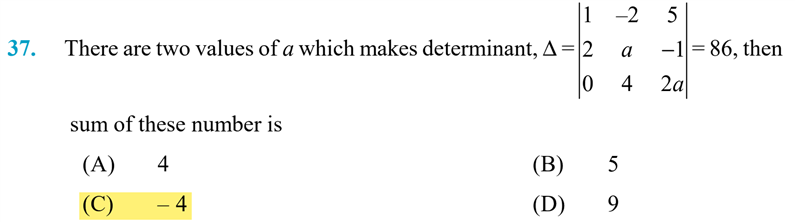
If \( \begin{vmatrix}1 & -2 & 5\\2 & \lambda & -1\\0 & 4 & 2\lambda\end{vmatrix}=86 \), the sum of the values of \( \lambda \) is:
Answer & explanation
Correct answer: option 2
The correct answer is Option (2) → −4
Expanding along the first column (it has a zero):
\( \displaystyle \Delta=1\begin{vmatrix}\lambda & -1\\4 & 2\lambda\end{vmatrix}-2\begin{vmatrix}-2 & 5\\4 & 2\lambda\end{vmatrix}+0 \)
\( \displaystyle =(2\lambda^2+4)-2(-4\lambda-20) \)
\( \displaystyle =2\lambda^2+8\lambda+44 \)
Setting this equal to 86:
\( \displaystyle 2\lambda^2+8\lambda-42=0 \)
\( \displaystyle \lambda^2+4\lambda-21=0 \)
\( \displaystyle (\lambda+7)(\lambda-3)=0 \)
\( \displaystyle \lambda=-7\ \text{or}\ 3 \)
Sum of the values = −7 + 3 = −4.
Shortcut: For \( \lambda^2+4\lambda-21=0 \) the sum of the roots is \( -\frac{b}{a}=-4 \); there is no need to solve the quadratic.
NCERT Exemplar:
Determinants