
CUETMOCK
  • Pricing
  • Mentors
Log inStart freeStart free mocks→

First test, then trust

Try a free CUET mock test.

Join 5,00,000+ students who rehearsed exam day on the exact NTA screen before sitting CUET. On the web and on Android.

Start free mocks →Get the Android app
CUETMOCK

India's #1 CUET Mock Test Platform. Original NCERT-based questions on the exact NTA exam screen — trusted by 5,00,000+ students since CUET 2022.

Get it onGoogle PlayScan to download the CUETMOCK app

Mock tests

  • CUET mock test series
  • Commerce mocks
  • Humanities (Arts) mocks
  • Science mocks
  • Languages & GAT mocks
  • Free practice questions
  • Pricing

Resources

  • CUET exam guide
  • CUET syllabus
  • Universities accepting CUET
  • Expert blogs
  • News & notifications
  • Webinars & counselling
  • CUET score calculator
  • How we estimate your rank
  • FAQs

Company

  • About us
  • Our leadership & team
  • Our toppers
  • Mentors
  • For schools
  • Contact us
  • Terms
  • Privacy
  • Refund policy

Talk to us

+91 7696 6630 56info@cuetmock.comWhatsApp us

Our other platforms

  • JEE Mock — For IIT-JEE aspirants
  • NEET Mock — For NEET aspirants

Newsletter

Exam updates, study material and offers — no spam.

© 2026 NYC Ventures Pvt. Ltd.

701-702, Royal Business Park, Zirakpur, Punjab - 140603

  • Terms of use
  • Privacy policy
  • Refund policy
  • Contact us

iCUETMOCK is an independent preparation platform, not affiliated with the National Testing Agency (NTA). Always check exam details on the official NTA website.

  • Home
  • Mock tests
  • CUET guide
  • Pricing
  • Log in
Home/Practice questions/Chemistry
ChemistryOrganic: Amines

Identify the compound (D):

Organic chemistry (Amines)

An organic compound (A) with the molecular formula C8H9NO when treated with bromine in aqueous solution of sodium hydroxide gives a new compound (B) having the molecular formula C7H9N. The compound (B) on heating with chloroform and ethanolic potassium hydroxide forms a compound (C) having foul-smelling. Further, the compound (B) gives an alkali soluble sulphonamide on reacting with benzenesulfonyl chloride.

Moreover, a thermally unstable compound (D) is obtained when the compound (B) reacts with sodium nitrite in concentrated hydrochloric acid at very low temperature. Further, the compound (D) on heating with water yields a compound which gives colour with neutral ferric chloride solution.

Answer the following questions on the basis of this passage.

Identify the compound (D):

Answer & explanation+

Correct answer: option 3

The correct answer is Option (3) → 4-methylbenzenediazonium chloride

Work through the passage one clue at a time:

  • A (C8H9NO) → B (C7H9N) with Br2/NaOH: this is the Hofmann bromamide degradation. It turns an amide into a primary amine with one carbon atom fewer, so A is an amide and B is a primary amine.

        \( \displaystyle \ce{CH3C6H4CONH2 + Br2 + 4NaOH -> CH3C6H4NH2 + Na2CO3 + 2NaBr + 2H2O} \)

  • B has 4 degrees of unsaturation: (2 × 7 + 2 + 1 − 9)/2 = 4, which fits a benzene ring. So B is a methyl-substituted aniline (toluidine).

  • Checks on B: it gives the carbylamine test and an alkali-soluble Hinsberg product, both of which confirm a primary amine.

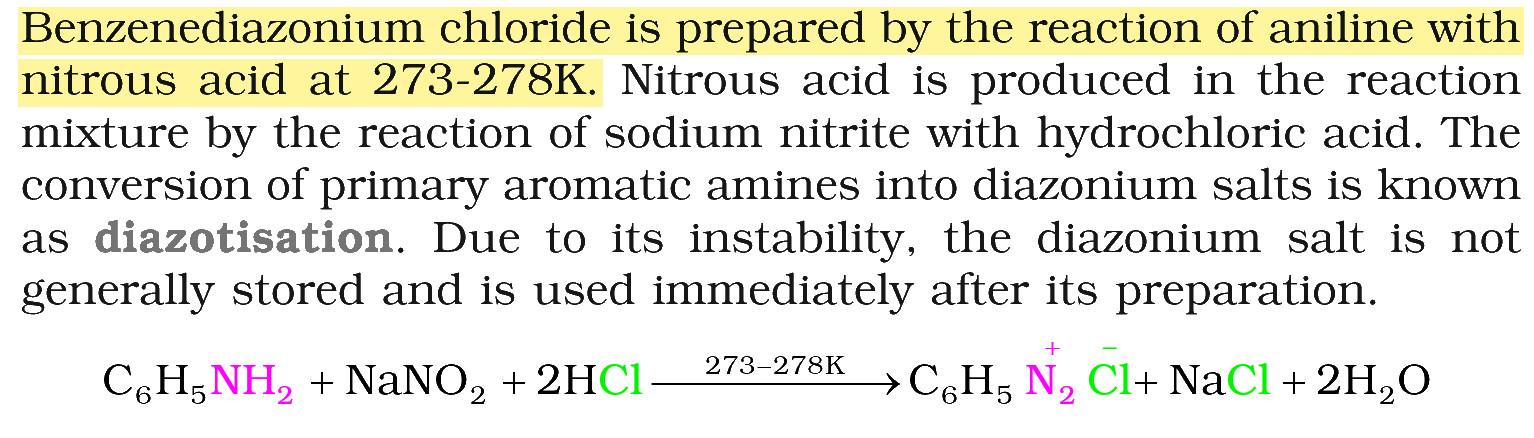
  • B + NaNO2/HCl at low temperature → D: a primary aromatic amine gives an arenediazonium salt. This is stable only at 273–278 K and decomposes on warming, which is why the passage calls it “thermally unstable”.

  • D + warm water → a compound that gives a colour with neutral FeCl3: that compound is a phenol, which confirms D is an aromatic diazonium salt.

    \( \displaystyle \ce{CH3C6H4NH2 + NaNO2 + 2HCl} \xrightarrow{\text{273-278 K}} \ce{CH3C6H4N2^+Cl^- + NaCl + 2H2O} \)

The passage does not say where the methyl group is, but every option shows the para isomer. So D is 4-methylbenzenediazonium chloride (p-toluenediazonium chloride).

Why the other options are incorrect

  • Option (1) 4-methylcyclohexanediazonium chloride — Incorrect. Aliphatic diazonium salts are too unstable to form even at low temperature; they lose \( \ce{N2} \) at once. Also, heating one with water would give an alcohol, which gives no colour with \( \ce{FeCl3} \).

  • Option (2) 4-methylphenol (p-cresol) — Incorrect. This is the product formed when D is warmed with water, not D itself.

  • Option (4) 4-methylaniline (p-toluidine) — Incorrect. This is compound B, the amine that is diazotised to give D.

NCERT (2026-27 edition):
Method of Preparation of Diazonium Salts
Textbook extract

Advertisement

Practise more on Organic: Amines

Chapter-wise mocks on the real NTA exam screen, with solutions and your rank. Your first mocks are free.

Start free mocks →

Advertisement

Next questions

  1. The value of 3^16 (mod 4) is:Applied Maths. Section B2 · Numbers, Quantification and Numerical Applications
  2. If we know the occupation and income of a child's parents, we can clearly identify about child's :Sociology · Indian Society: Introducing Indian Society
  3. The speed of a 90 metre long train is 45 km/h. A man is standing right next to the railway line. How much time will the train take to cross…General Aptitude Test · Numerical Ability
  4. If A= […] and B= […] , then A+B is equal toApplied Maths. Section B2 · Algebra
  5. Vandana and Megha are partners sharing profits in the ratio of 4:3. They admit Gurisha as a new partner for 1/10th share in the future prof…Accountancy Part A · Admission of a Partner
  6. At which place a geothermal energy plant has been commissioned?Geography · India-People and Economy: Mineral and Energy resources
  7. Arrange the following ways of India in descending order of their length.A. East West CorridorB. North South CorridorC. National Waterway 3D…Geography · India-People and Economy: Transport and Communcation
  8. Fill in the blank in the following sentence with the most appropriate option:I was so reluctant, but now I am _______ the responsibility to…English · Grammar: Phrasal Verb
  9. Which woman member belonged to the United Provinces constituency?History · Modern India: Framing the Constitution
  10. “Tha’mma! I shouted.” The narrator shouted—English · Comprehension - (Narrative / Factual)