
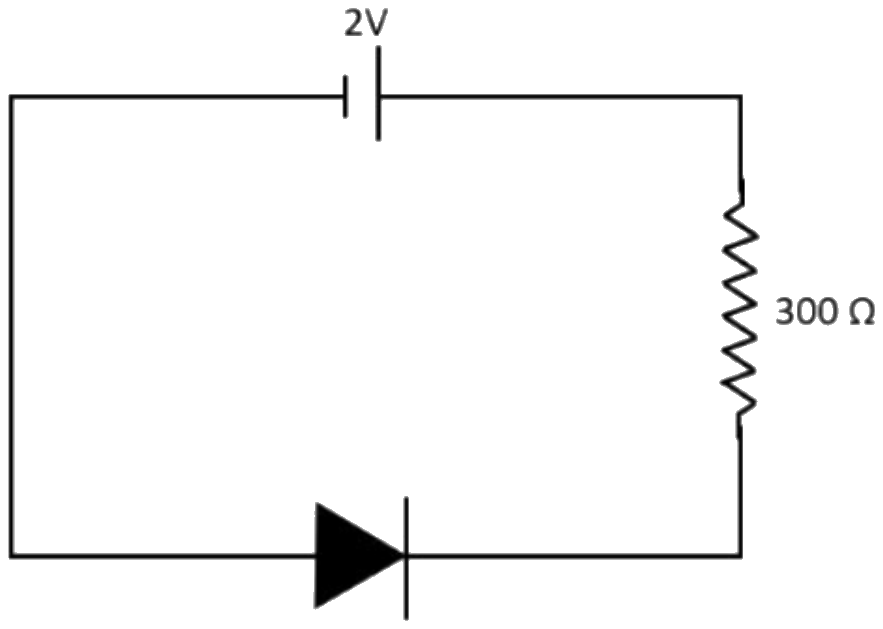
In the following circuit (see figure), the drift current through the diode is \( 50\ \mu\mathrm{A} \). The potential difference across the diode is
Answer & explanation
Correct answer: option 1
The correct answer is Option (1) → \( 1.985\ \mathrm{V} \)
From the cell symbol (longer plate positive), the positive terminal of the 2 V cell is connected through the \( 300\ \Omega \) resistor to the cathode (n-side) of the diode, so the diode is reverse biased. Only the small drift (reverse) current of \( 50\ \mu\mathrm{A} \) flows, and it flows through the resistor as well.
\( I = 50\ \mu\mathrm{A} = 50\times10^{-6}\ \mathrm{A} \)
\( V_{R} = IR = (50\times10^{-6}\ \mathrm{A})(300\ \Omega) = 0.015\ \mathrm{V} \)
By Kirchhoff’s loop rule the rest of the cell voltage appears across the diode:
\( V_{D} = 2\ \mathrm{V} - 0.015\ \mathrm{V} = 1.985\ \mathrm{V} \)