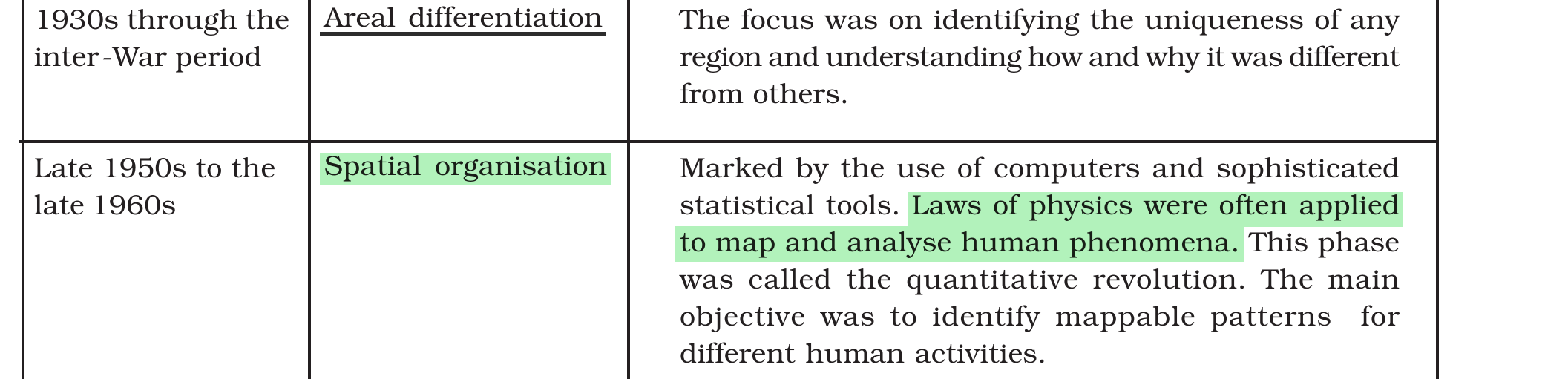
In which of the following approaches laws of physics were often applied to map and analyse human phenomena?
Answer & explanation
Correct answer: option 4
The correct answer is Option (4) → Spatial Organisation
Option (1) Welfare — Incorrect. The welfare school of the 1970s dealt with the social well-being of people, not statistical mapping.
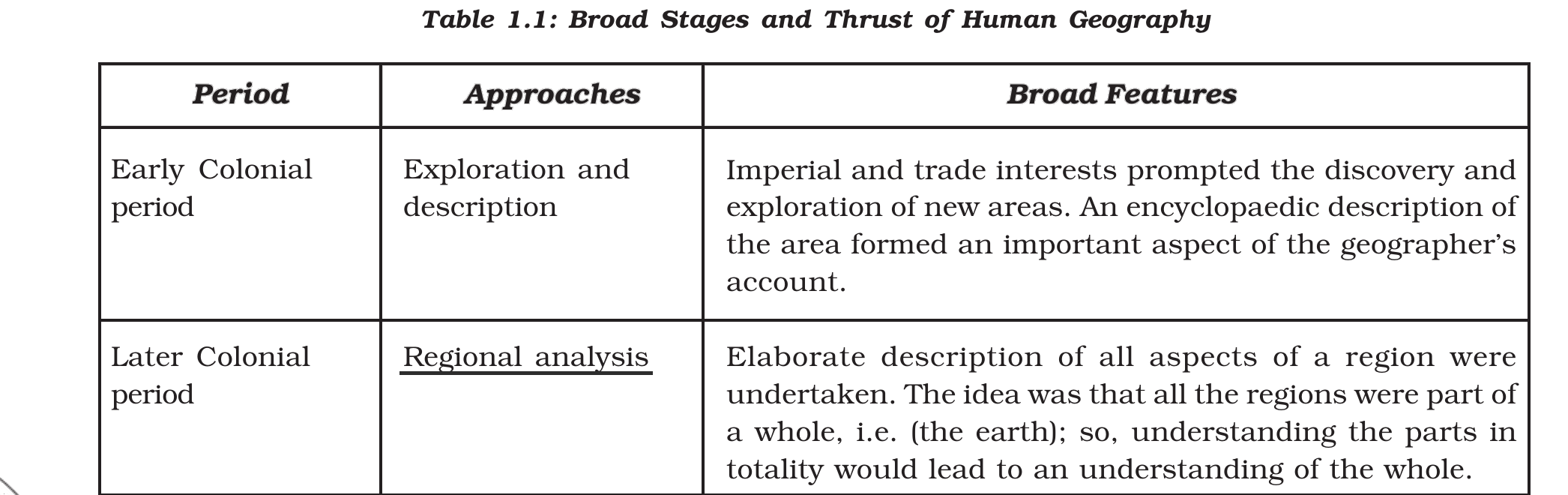
Option (2) Regional Analysis — Incorrect. Regional analysis (later colonial period) described all aspects of a region.
Option (3) Areal Differentiations — Incorrect. Areal differentiation (inter-War period) studied the uniqueness of each region.
Option (4) Spatial Organisation — Correct. From the late 1950s to the late 1960s, spatial organisation used computers and sophisticated statistical tools, and laws of physics were often applied to map and analyse human phenomena. This phase, called the quantitative revolution, looked for mappable patterns of human activities.
NCERT: Fundamentals of Human Geography — Chapter 1: Human Geography: Nature and Scope, Table 1.1: Broad Stages and Thrust of Human Geography (2025-26)
|