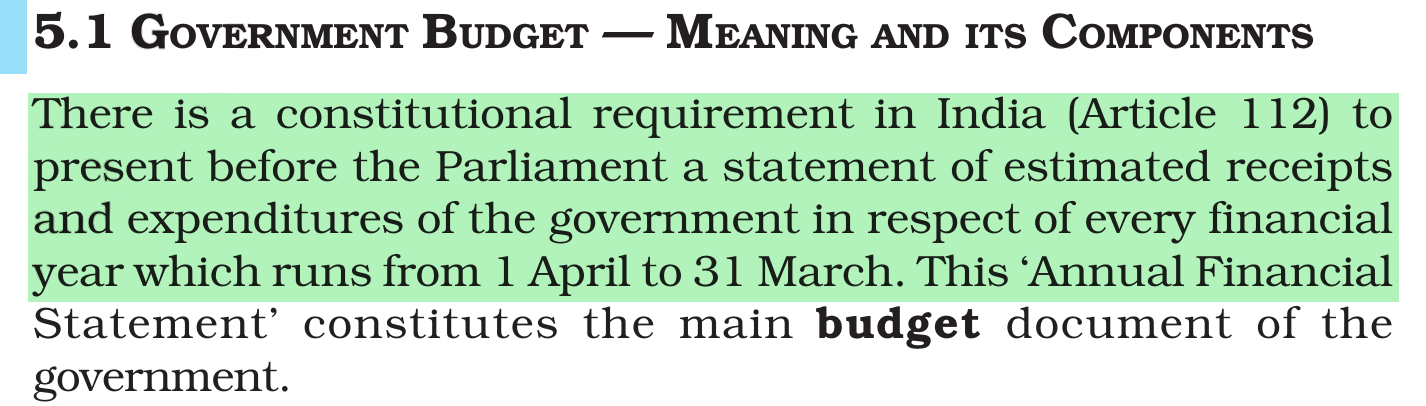
There is a constitutional requirement in India to present before Parliament a statement of estimated receipts and expenditures of government for each financial year, which runs from 1 April to 31 March. Which one of the following articles deals with this?
Answer & explanation
Correct answer: option 3
The correct answer is Option (3) → Article 112
Every year the government must tell Parliament how much it expects to collect and how much it plans to spend in the coming financial year, which runs from 1 April to 31 March. This is not left to choice: Article 112 of the Constitution requires a statement of estimated receipts and expenditures to be laid before Parliament for every year.
This statement, the Annual Financial Statement, is the main budget document of the government. It is divided into a revenue account (the revenue budget) and a capital account (the capital budget).
Why the other options are incorrect
Option (1) Article 110 — Incorrect. It defines a Money Bill, a bill dealing with taxes, borrowing or the Consolidated Fund; it does not require the annual statement of receipts and expenditure.
Option (2) Article 280 — Incorrect. It provides for the Finance Commission, which recommends how tax revenue is shared between the Centre and the states, not for the annual budget.
Option (4) Article 266(1) — Incorrect. It sets up the Consolidated Fund of India, into which government revenues go; it does not deal with presenting the budget to Parliament.
NCERT: Introductory Macroeconomics — Chapter 5: Government Budget and the Economy (2025-26)
|