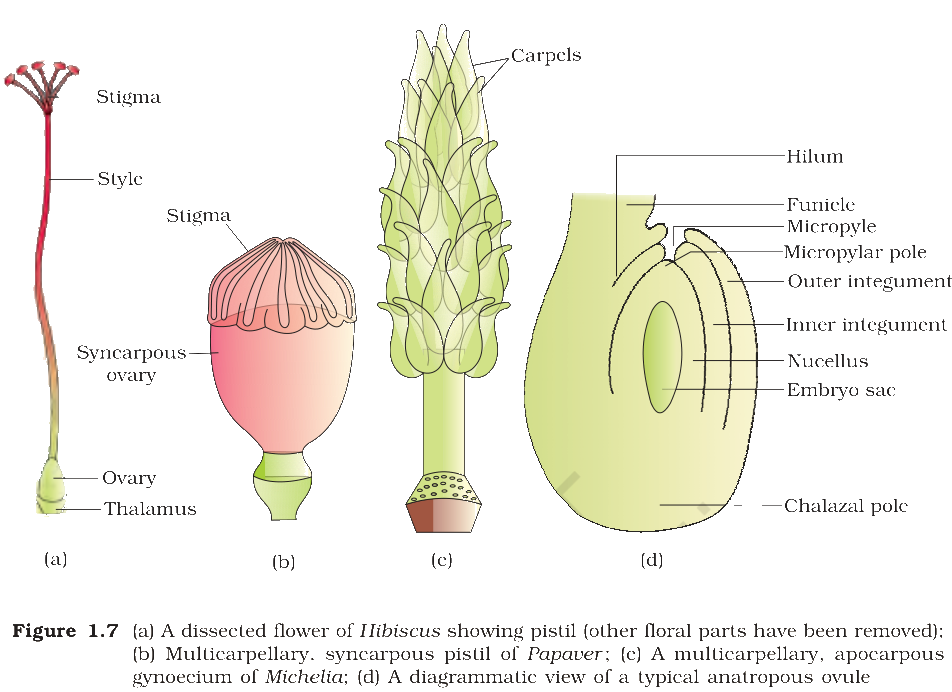
Which of following statements are best suited regarding the structure of typical angiosperm ovule.
A. It is also known as megasporangium.
B. Embryo sac at maturity is 7-nucleate 8-celled structure
C. Chalazal pole is opposite to the micropylar pole.
D. Chalaza represents the basal part of the ovule.
Choose the correct answer from the options given below:
Answer & explanation
Correct answer: option 3
The correct answer is Option (3) → A, C and D only
The ovule is the megasporangium of a flowering plant. It is joined to the placenta by a stalk, the funicle. It has one or two protective envelopes, the integuments, which leave a small opening, the micropyle. Inside them lies the nucellus, which holds the embryo sac.
(A) It is also known as megasporangium. — Correct. The megasporangia that arise from the placenta are commonly called ovules.
(B) Embryo sac at maturity is 7-nucleate 8-celled structure — Incorrect. It is the other way round. The mature embryo sac is 8-nucleate and 7-celled. It has three cells at the micropylar end (the egg and two synergids), three antipodal cells at the chalazal end, and one large central cell that has two polar nuclei. That makes 7 cells and 8 nuclei.
(C) Chalazal pole is opposite to the micropylar pole. — Correct. The chalaza lies at the end opposite the micropyle.
(D) Chalaza represents the basal part of the ovule. — Correct. The chalaza is the basal part of the ovule.
NCERT Extract:
The Pistil, Megasporangium (ovule) and Embryo Sac – “… The Megasporangium (Ovule) : Let us familiarise ourselves with the structure of a typical angiosperm ovule (Figure 1.7d). The ovule is a small structure attached to the placenta by means of a stalk called funicle. The body of the ovule fuses with funicle in the region called hilum. Thus, hilum represents the junction between ovule and funicle. Each ovule has one or two protective envelopes called integuments. Integuments encircle the nucellus except at the tip where a small opening called the micropyle is organised. Opposite the micropylar end, is the chalaza, representing the basal part of the ovule. Enclosed within the integuments is a mass of cells called the nucellus. Cells of the nucellus have abundant reserve food materials. Located in the nucellus is the embryo sac or female gametophyte.”