The cell for the following reaction can be represented as
Mg (s) + 2Ag+ (aq.) → Mg2+ (aq.) + 2Ag (s)
Answer & explanation
Correct answer: option 2
The correct answer is Option (2) → Mg|Mg2+ ||Ag+|Ag
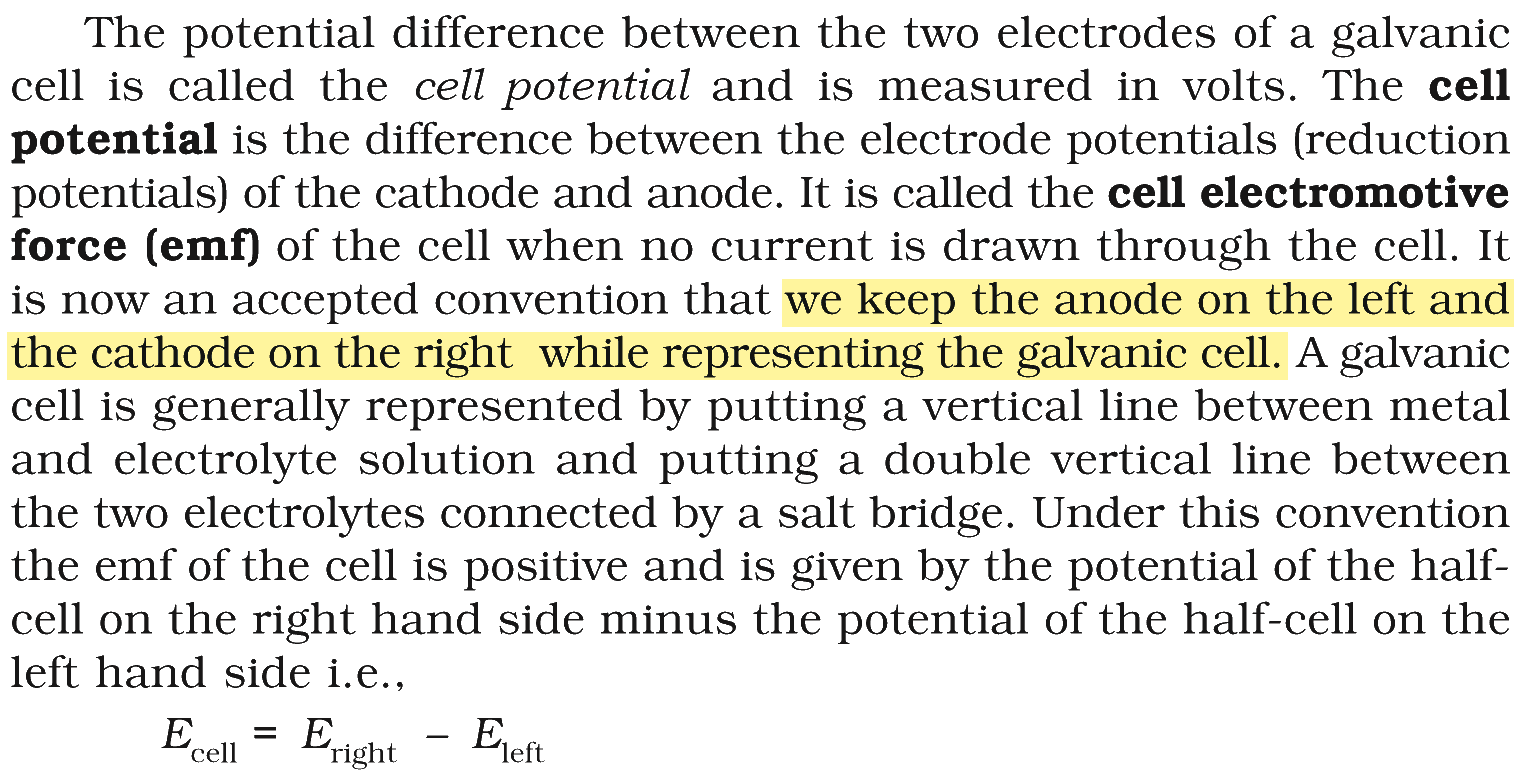
In the cell notation, the anode (oxidation) is written on the left and the cathode (reduction) on the right; a single line separates a metal from its solution and a double line stands for the salt bridge. Each half-cell is written in the direction of its change: anode metal | ion, cathode ion | metal.
In the given reaction, magnesium loses electrons and silver ions gain them:
Anode (oxidation): \( \ce{Mg(s) -> Mg^2+(aq) + 2e^-} \)
Cathode (reduction): \( \ce{2Ag^+(aq) + 2e^- -> 2Ag(s)} \)
So the cell is represented as Mg|Mg2+||Ag+|Ag.
Why the other options are incorrect
Option (1) Ag|Ag+ ||Mg2+|Mg — Incorrect. This puts silver as the anode, which represents the reverse, non-spontaneous reaction.
Option (3) Mg2+| Mg||Ag|Ag+ — Incorrect. Both half-cells are written in the wrong direction (ion | metal at the anode, metal | ion at the cathode).
Option (4) Ag+|Ag ||Mg|Mg2+ — Incorrect. The anode and cathode are swapped, and each half-cell is also written the wrong way round.
NCERT (2026-27 edition):
Galvanic Cells – …