Aldol Condensation
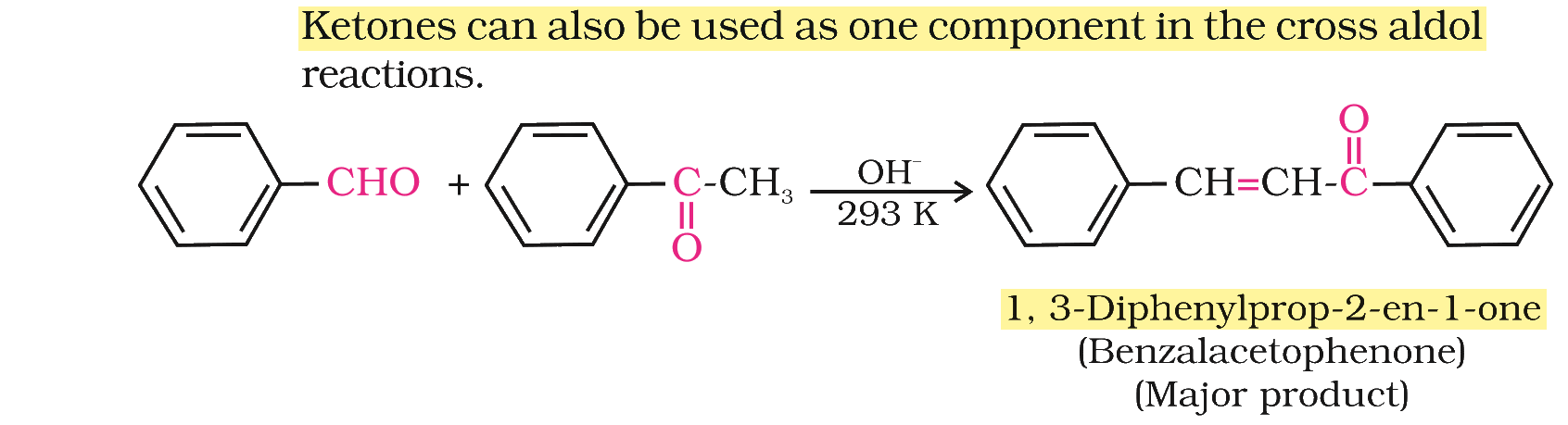
Aldehydes and ketones undergo a number of reactions due to the acidic nature of α-hydrogen. Aldehydes and ketones having at least one α-hydrogen undergo a reaction in the presence of dilute alkali as catalyst to form β-hydroxy aldehydes or β-hydroxy ketones, respectively. This is known as aldol reaction. The aldol and ketol readily lose water to give α, β-unsaturated carbonyl compounds, which are aldol condensation products; the reaction is called aldol condensation. When aldol condensation is carried out between two different aldehydes and/or ketones, it is called cross aldol condensation. Ethanal and propanal undergo this reaction to form mixture of products. However, benzaldehyde and acetophenone react to give only one product . Moreover, aldehydes which do not have an α-hydrogen atom, undergo self oxidation and reduction ( disproportionation) reaction on heating with concentrated alkali. The reaction is known as Cannizzaro reaction. In this reaction, one molecule of the aldehyde is reduced to alcohol while another is oxidised to carboxylic acid salt.
What is the IUPAC name of the product formed from the aldol reaction between benzaldehyde and acetophenone ?
Answer & explanation
Correct answer: option 1
The correct answer is Option (1) → 1,3 – Diphenylprop-2-en-one
Note: The given answer is as per the official NTA Answer Key. However, there is more than one correct option for this question, as explained below.
Benzaldehyde and acetophenone give C6H5–CH=CH–CO–C6H5. Its full IUPAC name is 1,3-diphenylprop-2-en-1-one.
Option (1) 1,3-Diphenylprop-2-en-one — Correct. It leaves out the locant of the C=O group.
Option (4) 1,3-Diphenylpropenone — Is also correct. It leaves out both locants. In a three-carbon chain with a ketone group and a double bond, the only possible structure is still \( \ce{C6H5-CO-CH=CH-C6H5} \). So Option (1) and Option (4) name the same compound.
The question also says “aldol reaction”. The aldol product itself would be 3-hydroxy-1,3-diphenylpropan-1-one, which is not among the options. So the question can only mean the product of aldol condensation, as the passage describes.
Aldol condensation between two different carbonyl compounds is called cross aldol condensation. When one partner has no α-hydrogen, it can only accept the attack of the carbanion, so a single product forms instead of a mixture. The reaction between an aromatic aldehyde and a ketone is known as the Claisen–Schmidt reaction.
Benzaldehyde has no α-hydrogen, while acetophenone has α-hydrogens in its \( \ce{CH3} \) group. In dilute alkali, acetophenone forms a carbanion, which adds to the C=O group of benzaldehyde. The β-hydroxy ketone formed loses water easily, because the new C=C bond is conjugated with both the benzene ring and the C=O group:
\( \displaystyle \ce{C6H5CHO + CH3COC6H5} \xrightarrow{\text{dil. NaOH}} \ce{C6H5CH=CH-CO-C6H5 + H2O} \)
Naming the product:
The chain has three carbon atoms, so the parent is propane.
The ketone carbon is C-1 and the double bond is between C-2 and C-3, giving prop-2-en-1-one.
Phenyl groups are on C-1 and C-3, giving 1,3-diphenyl.
So the product is 1,3-diphenylprop-2-en-1-one (benzalacetophenone, or chalcone).
NCERT (2026-27 edition):
Cross Aldol Condensation – …