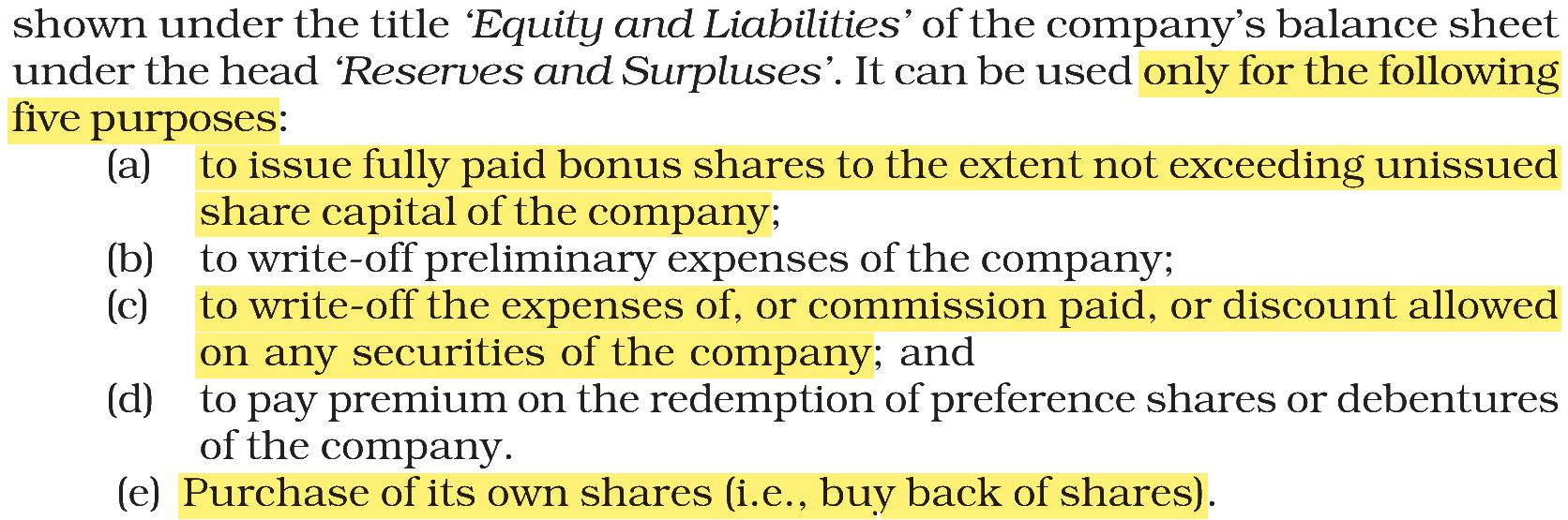
Securities Premium can be used only for the following purposes:
A. To issue fully paid bonus shares to the extent not exceeding unissued share capital of the company;
B. To issue partly paid bonus shares to the extent not exceeding unissued share capital of the company;
C. To write-off the expenses of, or commission paid, or discount allowed on any securities of the company; and
D. Purchase of its own shares (i.e., buy back of shares)
Choose the correct answer from the options given below:
Answer & explanation
Correct answer: option 2
The correct answer is Option (2) → A, C and D only
The Securities Premium Account is a capital receipt, so the law allows it to be used only for a fixed list of purposes. Each statement is checked against that list.
A. To issue fully paid bonus shares to the extent not exceeding unissued share capital of the company; Correct. Issuing fully paid bonus shares is the first permitted use. The premium is turned into share capital and handed to the shareholders as free shares.
B. To issue partly paid bonus shares to the extent not exceeding unissued share capital of the company; Incorrect. The premium can be used for fully paid bonus shares only. Using it to pay up part of the shares would leave the members owing the rest, which the law does not allow out of this account. The one word “partly” makes the statement wrong.
C. To write-off the expenses of, or commission paid, or discount allowed on any securities of the company; and Correct. Costs of issuing securities, such as commission and discount, may be written off against the premium.
D. Purchase of its own shares (i.e., buy back of shares) Correct. A company may use the premium to buy back its own shares.
NCERT (2026-27 edition):
|