
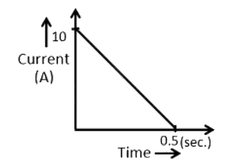
In a coil of resistance 100 Ω, a current is induced by changing the magnetic flux through it. The current vs time variation is as shown below. The magnitude of change in flux through the coil is -
Answer & explanation
Correct answer: option 1
The correct answer is Option (1) → 250 Wb
An induced emf drives a current \( I = \varepsilon/R \), and by Faraday’s law the emf is the rate of change of flux. So the charge that flows is fixed by the total change in flux:
\( \displaystyle I = \frac{1}{R}\,\frac{d\phi}{dt} \Rightarrow I\,dt = \frac{d\phi}{R} \)
\( \displaystyle q = \frac{\Delta\phi}{R} \Rightarrow \Delta\phi = qR \)
The charge that flows is the area under the current–time graph. From the graph the current falls uniformly from 10 A to zero in 0.5 s, so the area is a triangle:
\( \displaystyle q = \frac{1}{2} \times 10\,\mathrm{A} \times 0.5\,\mathrm{s} = 2.5\,\mathrm{C} \)
\( \displaystyle \Delta\phi = 2.5\,\mathrm{C} \times 100\,\Omega = 250\,\mathrm{Wb} \)