Which of the following conditions of the indifference curve is violated when two indifference curves are intersecting each other?
Answer & explanation
Correct answer: option 2
The correct answer is Option (2) → Higher indifference curve gives a higher level of satisfaction.
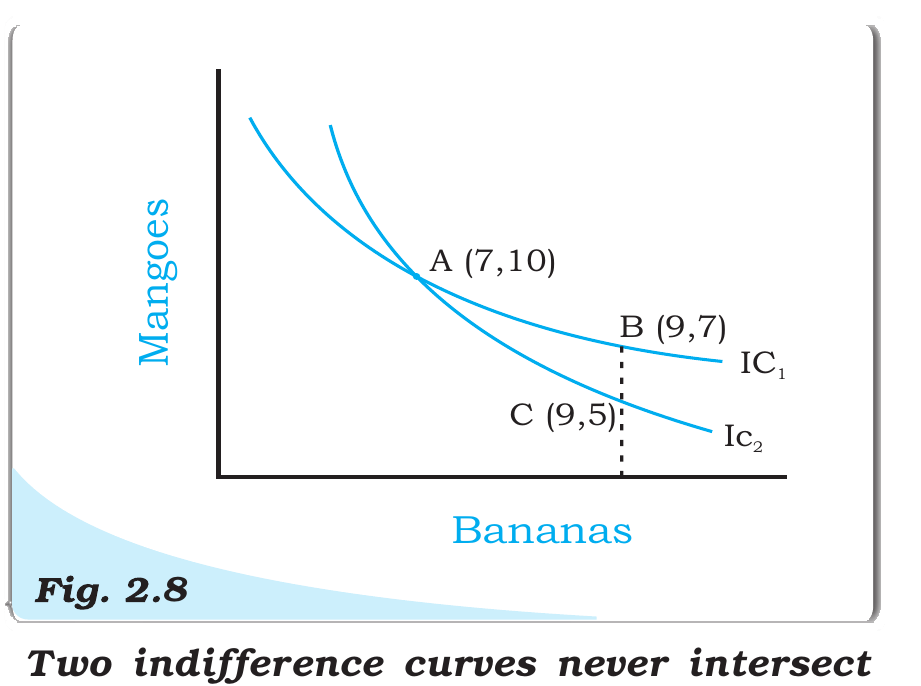
An indifference curve joins all the bundles of two goods that give the consumer the same level of satisfaction. With monotonic preferences more of a good is always better, so a higher indifference curve gives a higher level of satisfaction. See what happens if two curves cut each other at a point A:
Take B on the first curve and C on the second, with the same quantity of bananas but more mangoes at B.
B gives the same satisfaction as A (same curve), and A the same as C (same curve), so B and C would give equal satisfaction.
But B has more mangoes, so the consumer is better off at B: the curve through B is the higher one and should give more satisfaction.
The two cannot both be true, so crossing curves would break the rule that the higher curve gives more satisfaction. This is why two indifference curves never intersect.
Why the other options are incorrect
Option (1) The indifference curve slopes downward from left to right. — Incorrect. Each of two crossing curves can still slope downward; the downward slope only says that to have more of one good the consumer must give up some of the other. Crossing does not contradict it.
Option (3) Marginal rate of substitution can not be calculated. — Incorrect. The MRS is the slope of an indifference curve and can be worked out at any point of either curve. It is not a condition that crossing curves violate.
Option (4) Slope of the indifference curve is positive. — Incorrect. An indifference curve slopes downward, so its slope is negative. A positive slope is not a condition of indifference curves at all.
NCERT (2025-26): “2.Higher indifference curve gives greater level of utility: As long as marginal utility of a commodity is positive, an individual will always prefer more of that commodity, as more of the commodity will increase the level of satisfaction.… …3.Two indifference curves never intersect each other: Two indifference curves intersecting each other will lead to conflicting results. To explain this, let us allow two indifference curves to intersect each other as shown in the figure 2.8. As points A and B lie on the same indifference curve IC1, utilities derived from combination A and combination B will give the same level of satisfaction. Similarly, as points A and C lie on the same indifference curve IC2, utility derived from combination A and from combination C will give the same level of satisfaction. From this, it follows that utility from point B and from point C will also be the same. But this is clearly an absurd result, as on point B, the consumer gets a greater number of mangoes with the same quantity of bananas. So consumer is better off at point B than at point C. Thus, it is clear that intersecting indifference curves will lead to conflicting results. Thus, two indifference curves cannot intersect each other.”
|