
CUETMOCK
  • Pricing
  • Mentors
Log inStart freeStart free mocks→

First test, then trust

Try a free CUET mock test.

Join 5,00,000+ students who rehearsed exam day on the exact NTA screen before sitting CUET. On the web and on Android.

Start free mocks →Get the Android app
CUETMOCK

India's #1 CUET Mock Test Platform. Original NCERT-based questions on the exact NTA exam screen — trusted by 5,00,000+ students since CUET 2022.

Get it onGoogle PlayScan to download the CUETMOCK app

Mock tests

  • CUET mock test series
  • Commerce mocks
  • Humanities (Arts) mocks
  • Science mocks
  • Languages & GAT mocks
  • Free practice questions
  • Pricing

Resources

  • CUET exam guide
  • CUET syllabus
  • Universities accepting CUET
  • Expert blogs
  • News & notifications
  • Webinars & counselling
  • CUET score calculator
  • How we estimate your rank
  • FAQs

Company

  • About us
  • Our leadership & team
  • Our toppers
  • Mentors
  • For schools
  • Contact us
  • Terms
  • Privacy
  • Refund policy

Talk to us

+91 7696 6630 56info@cuetmock.comWhatsApp us

Our other platforms

  • JEE Mock — For IIT-JEE aspirants
  • NEET Mock — For NEET aspirants

Newsletter

Exam updates, study material and offers — no spam.

© 2026 NYC Ventures Pvt. Ltd.

701-702, Royal Business Park, Zirakpur, Punjab - 140603

  • Terms of use
  • Privacy policy
  • Refund policy
  • Contact us

iCUETMOCK is an independent preparation platform, not affiliated with the National Testing Agency (NTA). Always check exam details on the official NTA website.

  • Home
  • Mock tests
  • CUET guide
  • Pricing
  • Log in
Home/Practice questions/Biology
BiologyHuman Reproduction

Number of chromosomes present in spermatids are:

Number of chromosomes present in spermatids are:

Answer & explanation+

Correct answer: option 3

The correct answer is Option (3) → 23

In human spermatogenesis, the spermatogonia and primary spermatocytes are diploid, with 46 chromosomes. The first meiotic division halves the number. So each secondary spermatocyte has only 23 chromosomes. The second meiotic division separates the two chromatids of each chromosome. It does not reduce the number again, so each spermatid is haploid with 23 chromosomes. The sperm formed from a spermatid also has 23.

NCERT Extract:
Gametogenesis – “… A primary spermatocyte completes the first meiotic division (reduction division) leading to formation of two equal, haploid cells called secondary spermatocytes, which have only 23 chromosomes each. The secondary spermatocytes undergo the second meiotic division to produce four equal, haploid spermatids (Figure 2.5).”
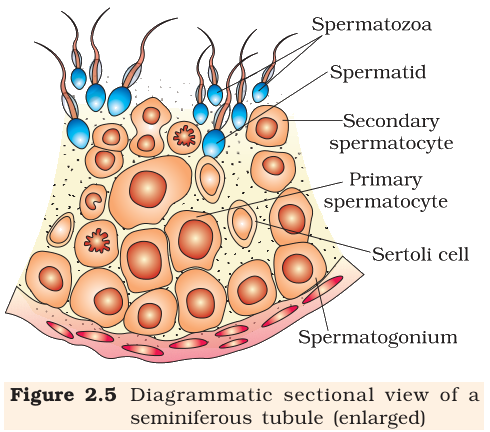
Textbook figure

Advertisement

Practise more on Human Reproduction

Chapter-wise mocks on the real NTA exam screen, with solutions and your rank. Your first mocks are free.

Start free mocks →

Advertisement

Next questions

  1. A machinist makes engine parts with an axle diameter of 0.6 inch. A random sample of 17 parts shows the mean diameter of 0.64 inch with a s…Applied Maths. Section B2 · Inferential Statistics
  2. The mean and variance of a Binomial distribution are 4 and 4/3 respectively. The number of trials isApplied Maths. Section B2 · Probability Distributions
  3. If P=displaystyle1/14 […] and P^-1= […] , then the value of x and y respectively areMaths. Section A · Determinants (Section A)
  4. Translation involves formation of a polypeptide which is defined by the sequence of bases in the mRNA. The order in which the process is ca…Biology · Molecular Basis of Inheritance
  5. Solution of differential equation displaystyledy/dx=e^x-y+3x^2e^-y is:(where C is an arbitrary constant)Applied Maths. Section A · Differential Equations (Section A)
  6. What is an alternative to outsourcing?Geography · Fundamentals of Human Geography: Tertiary and Quaternary Activities
  7. In India, compact or clustered settlements in rural areas are generally found in _________ .Geography · India-People and Economy: Human Settlements
  8. 9 × 2 : 9 × 9 :: 9 × 5 : ?General Aptitude Test · Verbal Reasoning
  9. An electron jumps from the fourth state to first state in a hydrogen atom. The energy released due to transition isPhysics · Atoms
  10. Inductance of a coil is the ratio ofPhysics · Electromagnetic Induction