
Translation involves formation of a polypeptide which is defined by the sequence of bases in the mRNA. The order in which the process is carried out is:
(A) mRNA attaches with small and large subunits of ribosome
(B) Ribozyme catalyses the formation of peptide bond
(C) Amino acids are activated and are linked to their cognate tRNA
(D) tRNA linked with amino acids binds to P and A sites of large subunit
Choose the correct answer from the options given below:
Answer & explanation
Correct answer: option 2
The correct answer is Option (2) → (C), (A), (D), (B)
(C) Amino acids are activated and are linked to their cognate tRNA — this comes first. In the first phase the amino acids are activated with ATP and linked to their own tRNAs. This is called charging of tRNA.
(A) mRNA attaches with small and large subunits of ribosome — this comes second. The ribosome is inactive as two subunits. When the small subunit meets an mRNA, translation begins.
(D) tRNA linked with amino acids binds to P and A sites of large subunit — this comes third. The large subunit has two sites where successive charged tRNAs bind, so that their amino acids come close to each other.
(B) Ribozyme catalyses the formation of peptide bond — this comes last. The ribosome itself acts as the catalyst for the peptide bond. In bacteria this catalyst is the 23S rRNA, which is a ribozyme.
NCERT Extract:
Translation – “… Formation of a peptide bond requires energy. Therefore, in the first phase itself amino acids are activated in the presence of ATP and linked to their cognate tRNA – a process commonly called as charging of tRNA or aminoacylation of tRNA to be more specific.”
Translation – “… In its inactive state, it exists as two subunits; a large subunit and a small subunit. When the small subunit encounters an mRNA, the process of translation of the mRNA to protein begins. There are two sites in the large subunit, for subsequent amino acids to bind to and thus, be close enough to each other for the formation of a peptide bond. The ribosome also acts as a catalyst (23S rRNA in bacteria is the enzyme- ribozyme) for the formation of peptide bond.”
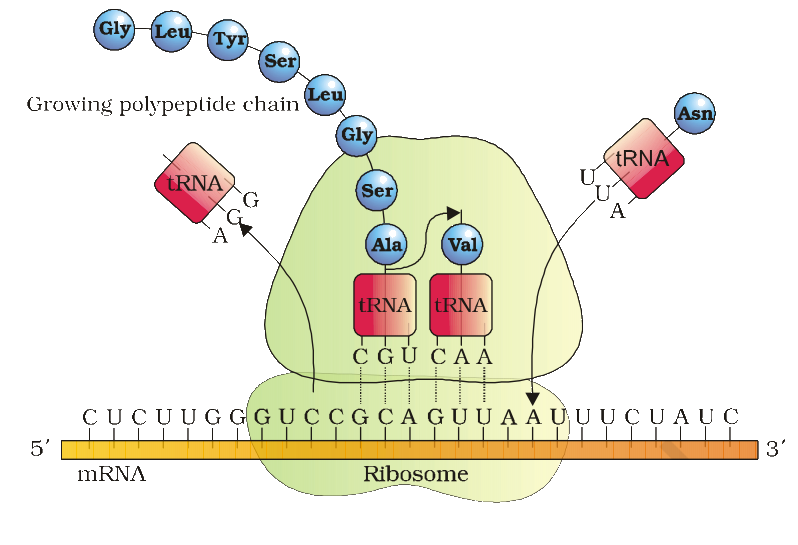
Figure 5.13 Translation