
The value of R in the given circuit, so that there is no current flow in the 10 Ω resistor, will be
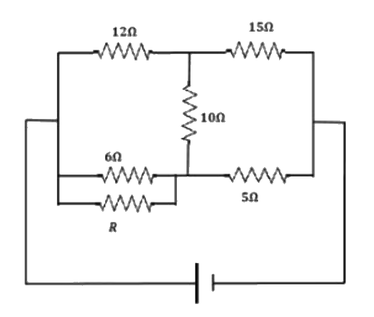
Answer & explanation
Correct answer: option 4
The correct answer is Option (4) → 12 Ω
No current flows in the 10 Ω resistor when the Wheatstone bridge is balanced, i.e. when its two junctions are at the same potential. Then the ratio of resistances in the upper arms equals the ratio in the lower arms.
The upper arms are 12 Ω and 15 Ω. The lower left arm is 6 Ω in parallel with R, and the lower right arm is 5 Ω.
\( \displaystyle \frac{12}{15} = \frac{R'}{5} \)
\( \displaystyle R' = \frac{12 \times 5}{15} = 4\,\Omega \)
\( \displaystyle R' = \frac{6R}{6 + R} = 4 \)
\( 6R = 24 + 4R \)
\( 2R = 24 \)
\( \displaystyle R = 12\,\Omega \)
Shortcut: The parallel combination must be 4 Ω. Test the options: 6 Ω in parallel with 12 Ω gives \( \frac{6 \times 12}{18} = 4 \) Ω, so Option (4) is right at once.