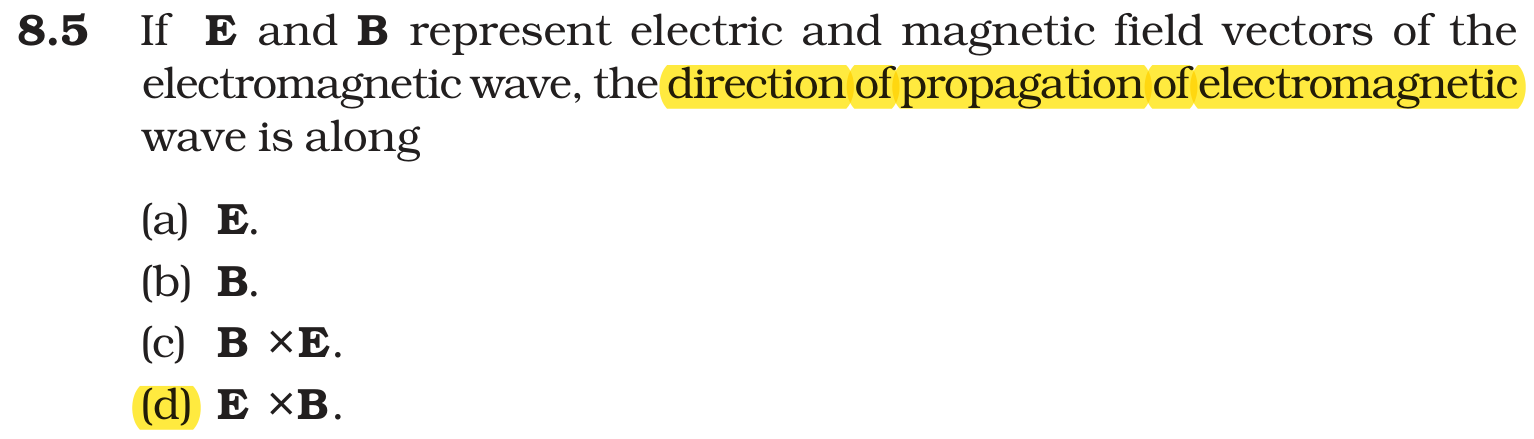
\( \vec{E} \) and \( \vec{B} \) represent electric and the magnetic field of an electromagnetic wave, respectively. The direction of propagation of the wave is along the direction of _______.
Answer & explanation
Correct answer: option 2
The correct answer is Option (2) → \( \vec{E}\times\vec{B} \)
An electromagnetic wave is transverse: \( \vec{E} \) and \( \vec{B} \) are perpendicular to each other and to the direction of travel. The direction of energy flow, given by the Poynting vector, is along
\( \displaystyle \vec{S} = \frac{1}{\mu_0}\,\vec{E}\times\vec{B} \)
So the wave propagates along \( \vec{E}\times\vec{B} \). For example, E along x and B along y give a wave travelling along +z, since \( \hat{\imath}\times\hat{\jmath} = \hat{k} \).
Why the other options are incorrect
Option (1) \( \vec{B} \) — Incorrect. \( \vec{B} \) is perpendicular to the direction of travel, not along it.
Option (3) \( \vec{E} \) — Incorrect. \( \vec{E} \) is perpendicular to the direction of travel, not along it.
Option (4) \( \vec{B}\times\vec{E} \) — Incorrect. \( \vec{B}\times\vec{E} = -\vec{E}\times\vec{B} \), which is the opposite direction; the order of the cross product matters.
Note: The same question was also asked in CUET (UG) 2023 on 31-05-2023 (Slot 2).
NCERT Exemplar:
Electromagnetic Waves – …