Match the LIST-I with LIST-II
| LIST-I | LIST-II | ||
|---|---|---|---|
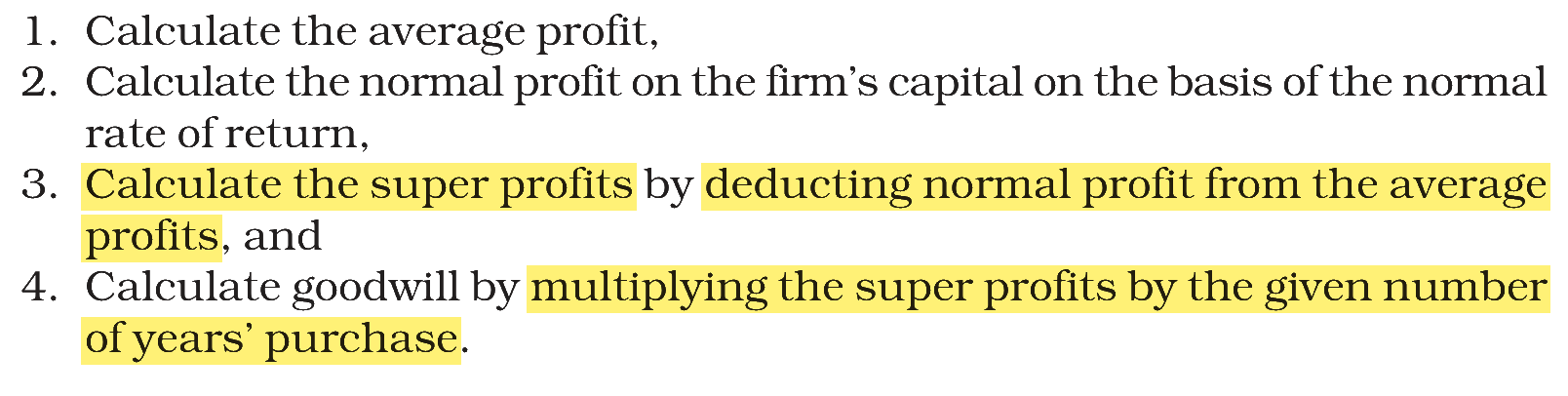
| A. | Average Profit | I. | Average profit - Normal profit |
| B. | Super Profit | II. | Super Profit x No. of Years of Purchases |
| C. | Super Profit Method | III. | Total Profit/ No. of Years |
| D. | Capitalised Value | IV. | Average Profit x 100/ Normal Rate of Return |
Choose the correct answer from the options given below:
Answer & explanation
Correct answer: option 4
The correct answer is Option (4) → A-III, B-I, C-II, D-IV
Each item of List-I is a term of goodwill valuation, and List-II gives its formula.
(A) Average Profit — this matches (III) Total Profit/ No. of Years. The profits of the past years are added and the total is divided by the number of those years.
(B) Super Profit — this matches (I) Average profit - Normal profit. It is the excess of the actual (average) profit over the normal profit that a similar business earns on the same capital.
(C) Super Profit Method — this matches (II) Super Profit x No. of Years of Purchases. Under this method goodwill is the super profit multiplied by the agreed number of years’ purchase.
(D) Capitalised Value — this matches (IV) Average Profit x 100/ Normal Rate of Return. The average profit is capitalised at the normal rate of return; the firm’s net assets are then deducted from it to get goodwill.
NCERT (2026-27 edition):
NCERT (2026-27 edition):
NCERT (2026-27 edition):
|