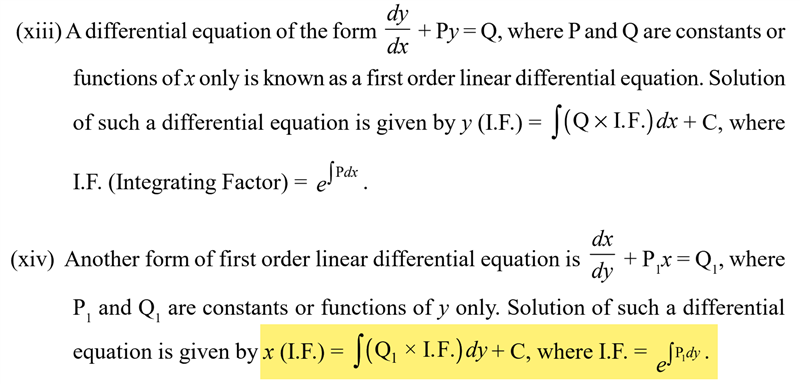
Consider the differential equation \( \displaystyle\frac{dx}{dy}+Px=Q \), where \( P \) and \( Q \) are function of \( y \). Then
(A) Its integrating factor (I.F.) is \( e^{\int P\,dy} \)
(B) Its integrating factor (I.F.) is \( e^{\int P\,dx} \)
(C) Its solution is given by \( x(\mathrm{I.F.})=\int Q(\mathrm{I.F.})\,dy+\mathrm{C} \)
(D) Its solution is given by \( y(\mathrm{I.F.})=\int Q(\mathrm{I.F.})\,dx+\mathrm{C} \)
Choose the correct answer from the options given below:
Answer & explanation
Correct answer: option 3
The correct answer is Option (3) → (A) and (C) only
In \( \frac{dx}{dy}+Px=Q \) the roles of x and y are exchanged compared with the usual form: x is the dependent variable and y is the independent variable, and P, Q are functions of y. Multiplying the equation by \( e^{\int P\,dy} \) makes the left side an exact derivative:
\( \displaystyle \frac{d}{dy}\left(x\,e^{\int P\,dy}\right)=Q\,e^{\int P\,dy} \)
\( \displaystyle x\,e^{\int P\,dy}=\int Q\,e^{\int P\,dy}\,dy+C \)
So the I.F. is \( e^{\int P\,dy} \), and the solution is \( x(\mathrm{I.F.})=\int Q(\mathrm{I.F.})\,dy+C \).
Checking the statements
(A) Its integrating factor (I.F.) is \( e^{\int P\,dy} \) — Correct. P is a function of y, so it is integrated with respect to y.
(B) Its integrating factor (I.F.) is \( e^{\int P\,dx} \) — Incorrect. P is a function of y, not of x.
(C) Its solution is given by \( x(\mathrm{I.F.})=\int Q(\mathrm{I.F.})\,dy+C \) — Correct. Integrating \( \frac{d}{dy}\left(x\cdot\mathrm{I.F.}\right)=Q\cdot\mathrm{I.F.} \) with respect to y gives this.
(D) Its solution is given by \( y(\mathrm{I.F.})=\int Q(\mathrm{I.F.})\,dx+C \) — Incorrect. This is the form for \( \frac{dy}{dx}+Py=Q \) with P, Q functions of x.
NCERT Exemplar:
Differential Equations