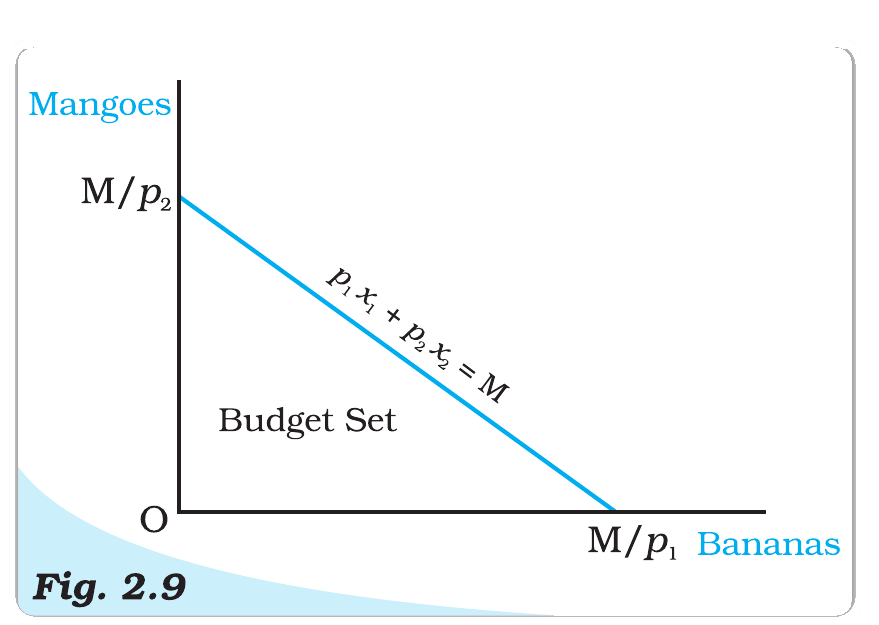
Which line consists of all bundles that cost exactly equal to consumer income?
Answer & explanation
Correct answer: option 3
The correct answer is Option (3) → Budget line
A consumer has a fixed income M and must pay the market prices p1 and p2. Some bundles of the two goods cost less than this income, some cost more than the consumer can pay, and some use up the whole income. These last bundles lie on a straight line, p1x1 + p2x2 = M, called the budget line.
The bundles on the line and below it, the ones the consumer can afford, form the budget set.
Why the other options are incorrect
Option (1) Production possibility curve — Incorrect. It shows the combinations of two goods an economy can produce with its resources and technology; it is about production, not a consumer’s income.
Option (2) Isocost line — Incorrect. An isocost line shows the combinations of inputs a firm can buy for the same total cost. It is the producer’s counterpart of the budget line, drawn for inputs, not for a consumer’s bundles.
Option (4) Isoquant line — Incorrect. An isoquant joins the input combinations that give the same level of output; it has nothing to do with income or prices.
NCERT (2025-26): “2.2.1 Budget Set and Budget Line … All bundles in the positive quadrant which are on or below the line are included in the budget set. The equation of the line is p1x1 + p2x2 = M (2.2) The line consists of all bundles which cost exactly equal to M. This line is called the budget line. Points below the budget line represent bundles which cost strictly less than M.…”
|