
CUETMOCK
  • Pricing
  • Mentors
Log inStart freeStart free mocks→

First test, then trust

Try a free CUET mock test.

Join 5,00,000+ students who rehearsed exam day on the exact NTA screen before sitting CUET. On the web and on Android.

Start free mocks →Get the Android app
CUETMOCK

India's #1 CUET Mock Test Platform. Original NCERT-based questions on the exact NTA exam screen — trusted by 5,00,000+ students since CUET 2022.

Get it onGoogle PlayScan to download the CUETMOCK app

Mock tests

  • CUET mock test series
  • Commerce mocks
  • Humanities (Arts) mocks
  • Science mocks
  • Languages & GAT mocks
  • Free practice questions
  • Pricing

Resources

  • CUET exam guide
  • CUET syllabus
  • Universities accepting CUET
  • Expert blogs
  • News & notifications
  • Webinars & counselling
  • CUET score calculator
  • How we estimate your rank
  • FAQs

Company

  • About us
  • Our leadership & team
  • Our toppers
  • Mentors
  • For schools
  • Contact us
  • Terms
  • Privacy
  • Refund policy

Talk to us

+91 7696 6630 56info@cuetmock.comWhatsApp us

Our other platforms

  • JEE Mock — For IIT-JEE aspirants
  • NEET Mock — For NEET aspirants

Newsletter

Exam updates, study material and offers — no spam.

© 2026 NYC Ventures Pvt. Ltd.

701-702, Royal Business Park, Zirakpur, Punjab - 140603

  • Terms of use
  • Privacy policy
  • Refund policy
  • Contact us

iCUETMOCK is an independent preparation platform, not affiliated with the National Testing Agency (NTA). Always check exam details on the official NTA website.

  • Home
  • Mock tests
  • CUET guide
  • Pricing
  • Log in
Home/Practice questions/Chemistry
ChemistryPhysical: Chemical Kinetics

The half-life of a first order reaction:

Passage

Chemical Kinetics

Some reactions such as ionic reactions occur very fast, for example, precipitation of silver chloride occurs instantaneously by mixing of aqueous solutions of silver nitrate and sodium chloride. On the other hand, some reactions are very slow, for example, rusting of iron in the presence of air and moisture. The sum of powers of the concentration of the reactants in the rate law expression is called the order of that chemical reaction. Another property of a reaction called molecularity helps in understanding its mechanism. The number of reacting species (atoms, ions or molecules) taking part in an elementary reaction, which must collide simultaneously in order to bring about a chemical reaction is called molecularity of a reaction. The half-life (t1/2) of a reaction is the time in which the concentration of a reactant is reduced to one-half of its initial concentration.

The half-life of a first order reaction:

Answer & explanation+

Correct answer: option 3

The correct answer is Option (3) → is independent of the reactant concentration.

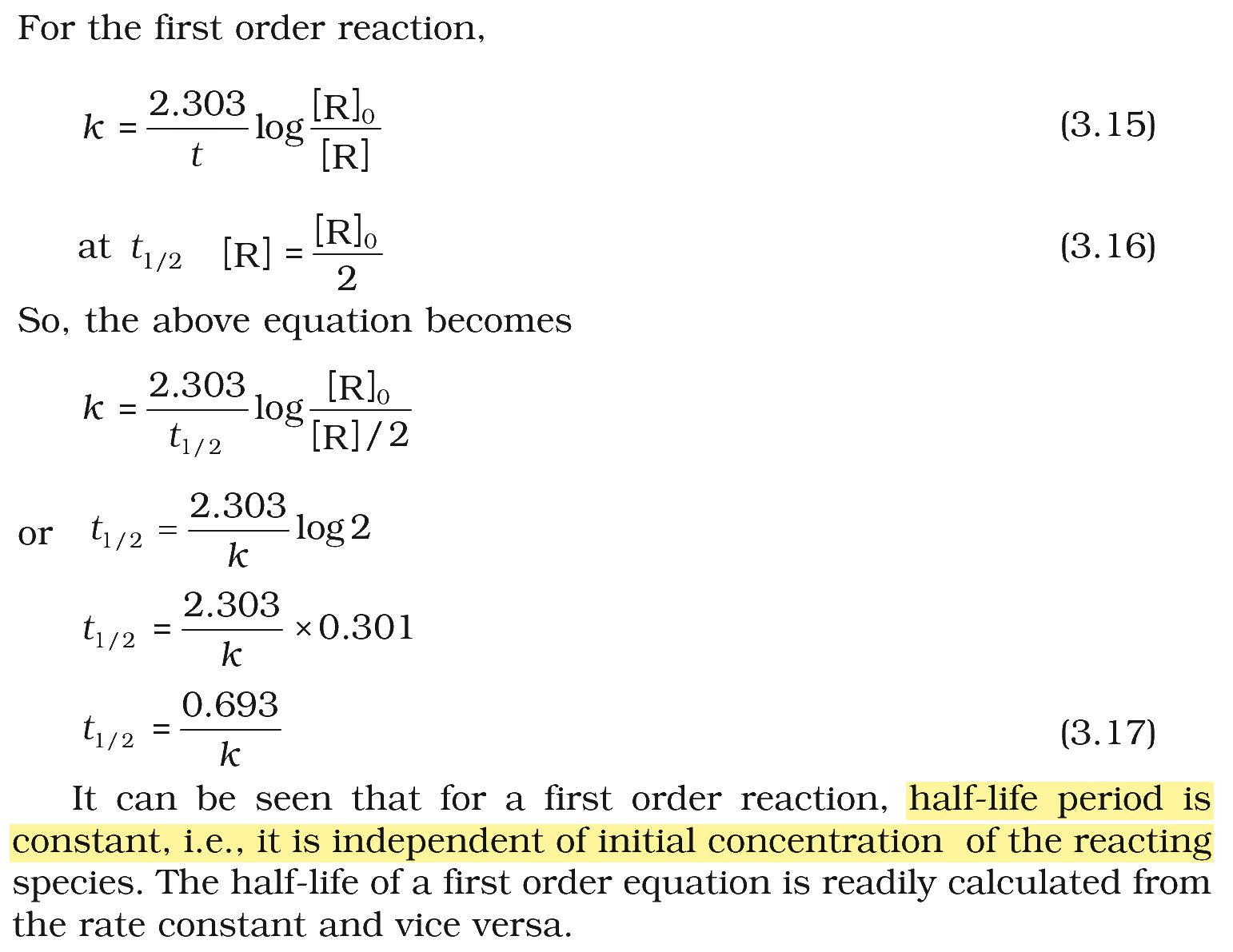
The half-life (t1/2) is the time in which the reactant concentration falls to half its initial value. For a first order reaction, putting [R] = [R]0/2 in the integrated rate equation gives:

    \( \displaystyle t_{1/2}=\frac{0.693}{k} \)

[R]0 has cancelled out: the half-life depends only on k. So for a first order reaction, t1/2 is independent of the reactant concentration; every half-life is equally long, whatever the starting amount.

Why the other options are incorrect

  • Option (1) is inversely proportional to the reactant concentration — Incorrect. This holds for a second order reaction, t1/2 = 1/(k[R]0).

  • Option (2) is inversely proportional to the square of the reactant concentration — Incorrect. This would be a third order reaction.

  • Option (4) depends on the reactant concentration raised to the first power — Incorrect. This holds for a zero order reaction, t1/2 = [R]0/2k.

NCERT (2026-27 edition):
Half-Life of a Reaction – …
Textbook extract

Advertisement

Practise more on Physical: Chemical Kinetics

Chapter-wise mocks on the real NTA exam screen, with solutions and your rank. Your first mocks are free.

Start free mocks →

Advertisement

Next questions

  1. ∫(cos 5x+cos 4x)/(1-2cos 3x) dx is equal to [ C is an arbitrary constant]Maths. Section B1 · Indefinite Integration
  2. What will be the product of the following reaction?Chemistry · Organic: Amines
  3. Arrange the following steps of Planning process in order:(A) Planning is concerned with the future which is uncertain and every planner is…Business Studies · Planning
  4. Select the correct word to substitute the following phrase from the options given below:-A vote by the people of a country or region on an…English · One Word
  5. Which of the following alkyl halides has the highest boiling point ?Chemistry · Organic: Haloalkanes and Haloarenes
  6. Minimum value of f(x)=x^2+displaystyle250/x , x≠ 0 isApplied Maths. Section A · Applications of Derivatives (Section A)
  7. Rig Veda is aGeneral Aptitude Test · General Knowledge
  8. “Planning requires logical and systematic thinking rather than guess work or wishful thinking”. The feature of planning highlighted in the…Business Studies · Planning
  9. As per section 68 of The Companies Act, 2013, the company cannot buy their own shares from either of the following source:Accountancy Part A · Accounting for Shares
  10. Two vectors a and b are inclined at angle θ=60^° such that |a|=1,\ |b|=2 , then ≤ft|(a+3b)×(3a-b)|^2 is equal toMaths. Section B1 · Vectors