Arrange the following compounds in decreasing order of the reactivity towards nucleophilic addition reaction.
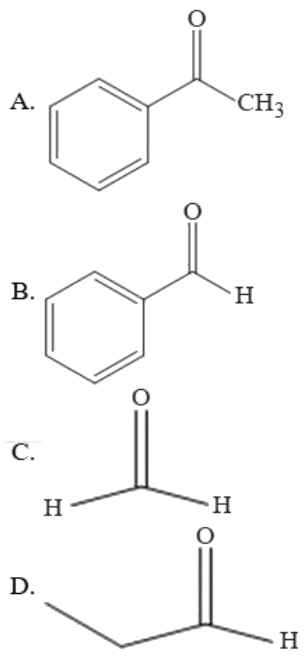
Choose the correct answer from the options given below:
Answer & explanation
Correct answer: option 2
The correct answer is Option (2) → C, D, B, A
In a nucleophilic addition, the nucleophile attacks the carbonyl carbon. The reactivity depends on two factors:
Steric factor: bulky groups around the carbonyl carbon hinder the attack. H is the smallest group, so aldehydes are more reactive than ketones, and HCHO is the most reactive.
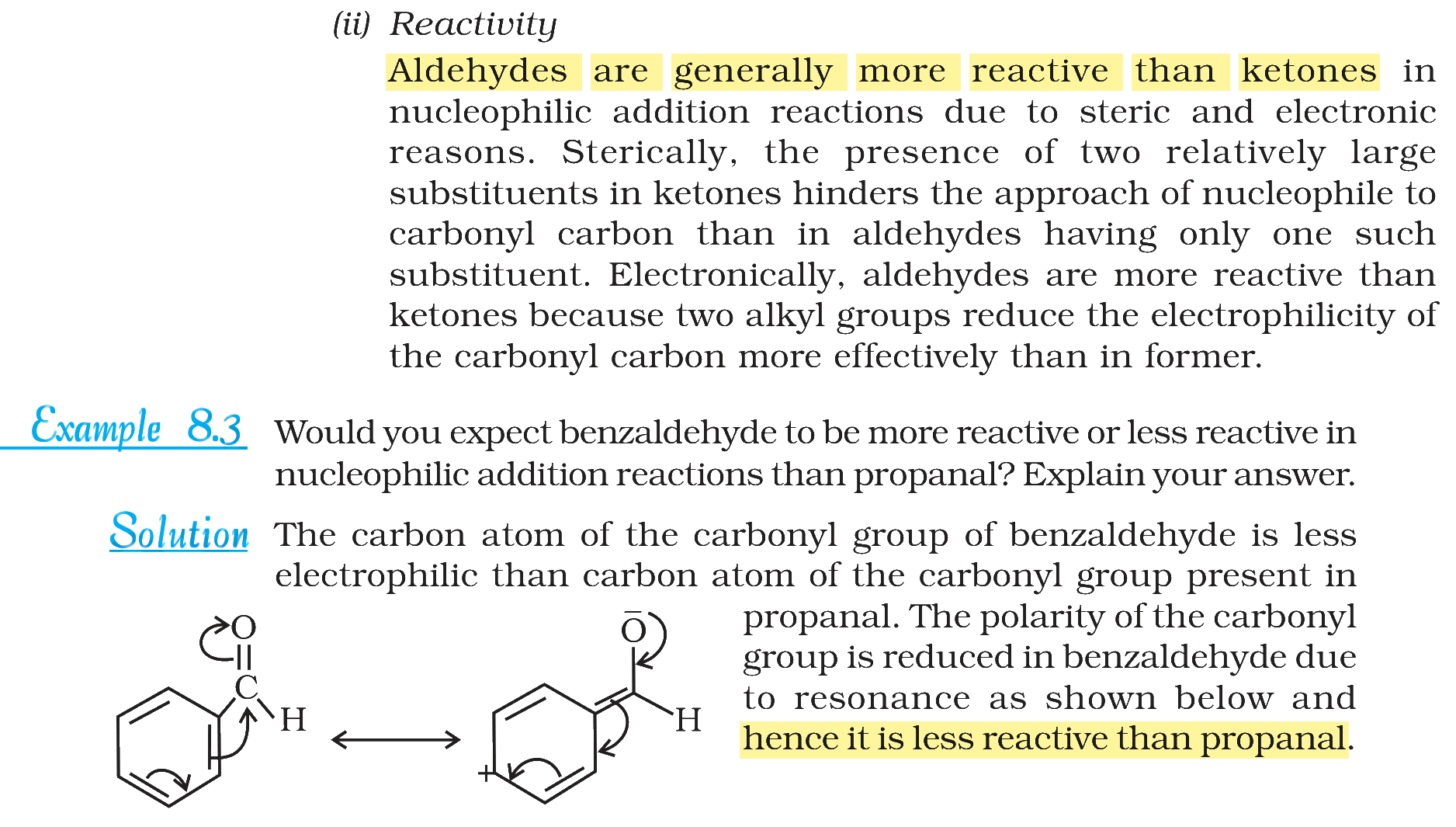
Electronic factor: groups that release electrons reduce the positive charge on the carbonyl carbon. Alkyl groups do this by the +I effect. A benzene ring does it more strongly, by resonance, so aromatic aldehydes and ketones are less reactive than aliphatic ones.
Matching the given compounds:
C: HCHO, formaldehyde (two H atoms): most reactive
D: \( \ce{CH3CH2CHO} \), propanal (aliphatic aldehyde)
B: \( \ce{C6H5CHO} \), benzaldehyde (aromatic aldehyde)
A: \( \ce{C6H5COCH3} \), acetophenone (aromatic ketone): least reactive
NCERT (2026-27 edition):
Reactivity