
Which of the following statements are correct for non-ideal solution?
(A) Change in enthalpy of mixing is zero
(B) Change in volume of mixing is not equal to zero
(C) They follow Raoult’s law over the entire range of concentration.
(D) Mixture of ethanol & acetone forms a non-ideal solution
Choose the correct answer from the options given below:
Answer & explanation
Correct answer: option 1
The correct answer is Option (1) → (B) and (D) only
An ideal solution obeys Raoult’s law over the entire range of concentration. The solute–solvent (A–B) interactions are of the same strength as the A–A and B–B interactions, so there is no heat change (ΔmixH = 0) and no volume change (ΔmixV = 0) on mixing.
A non-ideal solution does not obey Raoult’s law. Its A–B interactions are weaker (positive deviation) or stronger (negative deviation) than the A–A and B–B interactions, so ΔmixH ≠ 0 and ΔmixV ≠ 0.
(A) Change in enthalpy of mixing is zero — Incorrect. This is true only for an ideal solution; for a non-ideal solution heat is absorbed or released on mixing.
(B) Change in volume of mixing is not equal to zero — Correct. Weaker A–B attractions make the solution expand (ΔV > 0); stronger ones make it contract (ΔV < 0).
(C) They follow Raoult’s law over the entire range of concentration. — Incorrect. Obeying Raoult’s law over the whole range is the definition of an ideal solution.
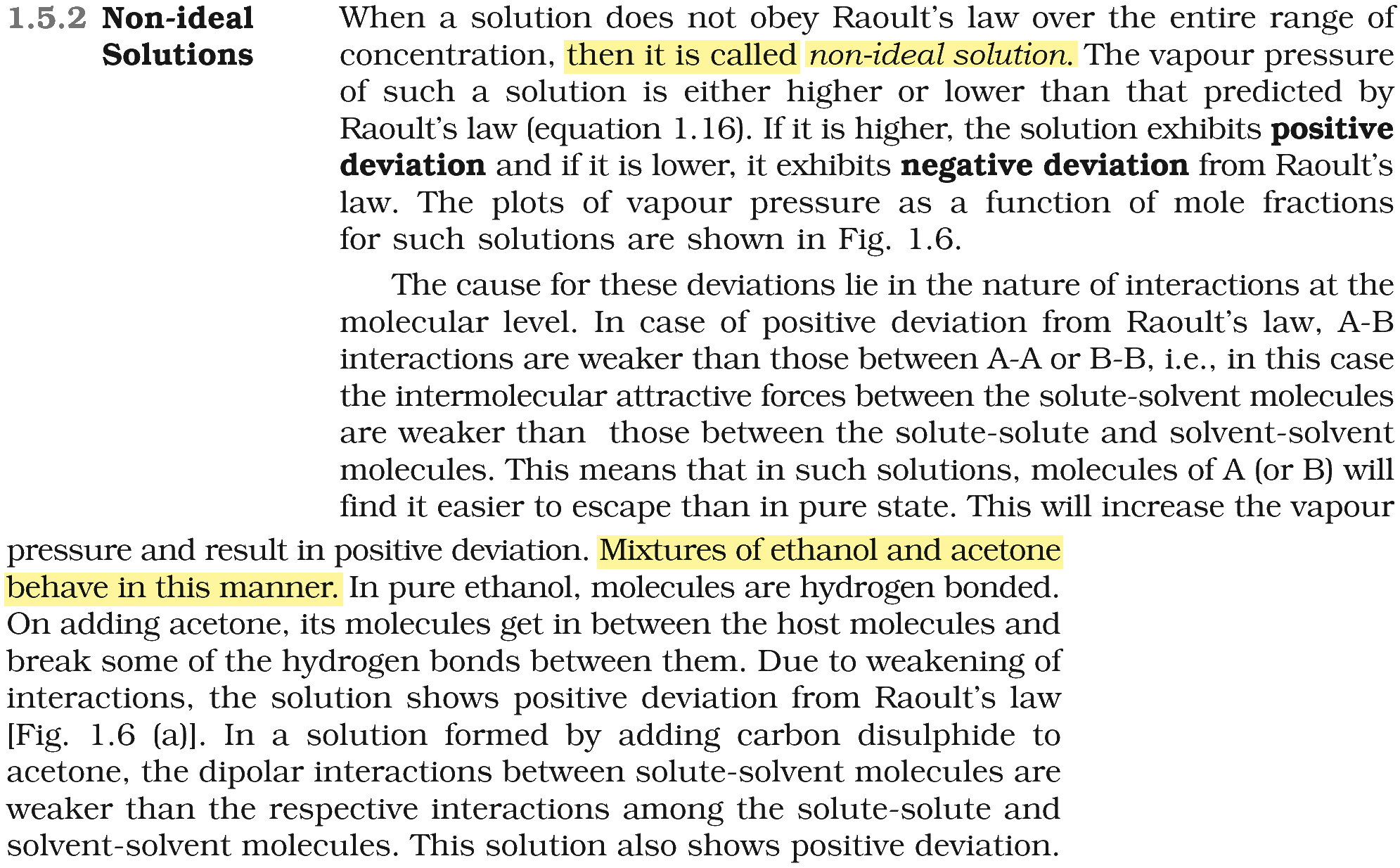
(D) Mixture of ethanol & acetone forms a non-ideal solution — Correct. Acetone molecules come between ethanol molecules and break some of their hydrogen bonds. The A–B interactions are weaker, so the mixture shows a positive deviation from Raoult’s law.
NCERT (2026-27 edition):
Non-ideal Solutions
Ideal Solutions – “The solutions which obey Raoult’s law over the entire range of concentration are known as ideal solutions. The ideal solutions have two other important properties. The enthalpy of mixing of the pure components to form the solution is zero and the volume of mixing is also zero, i.e.,
\( \displaystyle \Delta_{\text{mix}}H=0,\qquad \Delta_{\text{mix}}V=0 \)”