
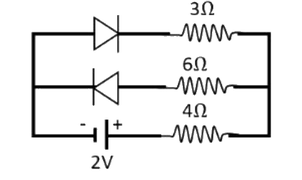
Two p-n junction diodes (ideal) are connected with external resistors and a battery of 2 V and negligible internal resistance as shown in the figure. The current drawn from the battery is
Answer & explanation
Correct answer: option 2
The correct answer is Option (2) → 0.20 A
A diode conducts only when it is forward biased, i.e. when current can flow in the direction of its arrow; an ideal diode then has zero resistance, and when reverse biased it acts as an open switch.
The battery’s positive terminal is on the right, so conventional current leaves it towards the right, flows through the 4 Ω resistor to the right-hand wire, and must return to the left-hand wire through the upper branches, i.e. from right to left.
The top diode points to the right, against this current, so it is reverse biased and the 3 Ω branch carries no current. The middle diode points to the left, along the current, so it is forward biased and the 6 Ω branch conducts. The circuit is therefore the battery in series with 4 Ω and 6 Ω.
\( \displaystyle I = \frac{V}{R_{\mathrm{total}}} = \frac{2\,\mathrm{V}}{4\,\Omega + 6\,\Omega} \)
\( I = 0.20\,\mathrm{A} \)