Organic synthesis and applications
In aldehydes, carbonyl group is bonded to carbon and hydrogen while in ketones, it is bonded to two carbon atoms. The carbonyl carbon atom is sp2-hybridised and a trigonal coplanar structure. The bond angles are approximately 120°. Methanal is gas at room temperature. Ethanal is a volatile liquid. Other aldehydes and ketones are liquid or solid at room temperature. The boiling points of aldehydes and ketones are higher than hydrocarbons and ether of comparable molecular masses. It is due to weak molecular association in aldehydes and ketones arising out of the dipole-dipole interactions. Their boiling points are lower than those of alcohols of similar molecular masses due to absence of intermolecular hydrogen bonding. The lower members of aldehydes and ketones are miscible with water because they form hydrogen bonding with water. However, the solubility of aldehydes and ketones decreases rapidly on increasing the length of alkyl chain.
Aldehydes are generally more reactive than ketones in the nucleophilic addition reactions due to steric and electronic reasons. An organic compound (A) with molecular formula C8H8O forms an orange-red precipitate with 2,4-DNP reagent and gives yellow precipitate on heating with iodine in the presence of sodium hydroxide. It neither reduces Tollens' or Fehling's reagent, nor does it decolourise bromine water or Baeyer's reagent. On drastic oxidation with chromic acid, it gives a carboxylic acid (B) having molecular formula C7H6O2.
The name of the reaction of two molecules of benzaldehyde with conc. NaOH on heating, is
Answer & explanation
Correct answer: option 3
The correct answer is Option (3) → Cannizzaro reaction.
What an aldehyde does with alkali depends on whether it has an α-hydrogen (an H on the carbon next to C=O):
Aldehydes with α-H (\( \ce{CH3CHO} \)) undergo aldol condensation with dilute alkali.
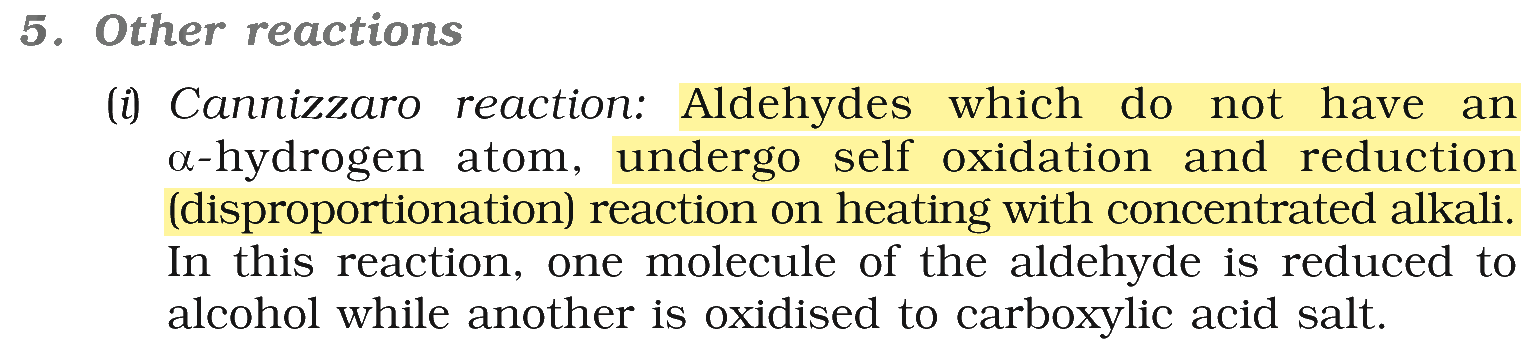
Aldehydes without α-H (HCHO, \( \ce{C6H5CHO} \)) undergo the Cannizzaro reaction with concentrated alkali on heating. It is a self oxidation–reduction (disproportionation): one molecule is reduced to an alcohol and the other is oxidised to the salt of a carboxylic acid.
Benzaldehyde has no α-hydrogen (the CHO group is attached directly to the ring), so two molecules react with conc. NaOH:
\( \displaystyle \ce{2C6H5CHO + NaOH} \xrightarrow{\text{conc., heat}} \ce{C6H5CH2OH + C6H5COONa} \)
So the reaction is the Cannizzaro reaction, giving benzyl alcohol and sodium benzoate.
Why the other options are incorrect
Option (1) Cross aldol condensation — Incorrect. It takes place between two different aldehydes or ketones, at least one having an α-H, in dilute alkali.
\( \displaystyle \ce{C6H5CHO + CH3CHO} \xrightarrow{\text{dil. }\ce{NaOH}} \ce{C6H5CH=CHCHO + H2O} \)
Option (2) Wolff-Kishner reduction — Incorrect. It reduces C=O to CH2 using hydrazine and then KOH in ethylene glycol; it is not a reaction of benzaldehyde with NaOH alone.
\( \displaystyle \ce{R2C=O} \xrightarrow{\ce{NH2NH2}} \ce{R2C=NNH2} \xrightarrow{\ce{KOH}/\text{ethylene glycol, heat}} \ce{R2CH2 + N2} \)
Option (4) Aldol condensation — Incorrect. It needs an α-hydrogen, which benzaldehyde does not have.
\( \displaystyle \ce{2CH3CHO} \xrightarrow{\text{dil. }\ce{NaOH}} \ce{CH3CH(OH)CH2CHO} \xrightarrow{\text{heat}} \ce{CH3CH=CHCHO + H2O} \)
NCERT (2026-27 edition):
Other Reactions