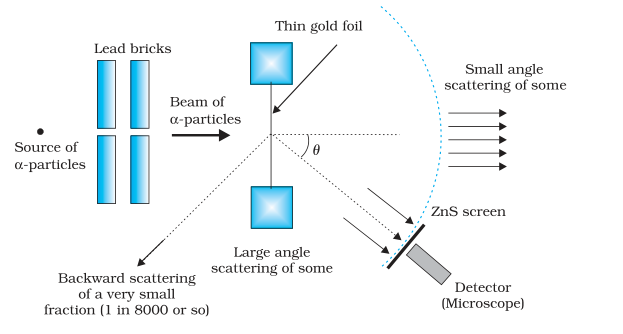
Which of the following is not a component of Geiger-Marsden experimental arrangement?
Answer & explanation
Correct answer: option 4
The correct answer is Option (4) → Electron gun
In the Geiger-Marsden (alpha-scattering) experiment, a beam of alpha particles from a radioactive source (214Bi), collimated by lead bricks, was directed at a thin gold foil. The scattered alpha particles were detected by the flashes (scintillations) they produced on a zinc sulphide screen, which were observed through a microscope that could be rotated to different scattering angles.
The projectiles were alpha particles, not electrons, so an electron gun is not part of the arrangement.
NCERT (2026-27):
Alpha-particle Scattering and Rutherford’s Nuclear Model of Atom – “… Alpha-particles emitted by a 21483Bi radioactive source were collimated into a narrow beam by their passage through lead bricks. The beam was allowed to fall on a thin foil of gold of thickness 2.1 × 10⁻⁷ m. The scattered alpha-particles were observed through a rotatable detector consisting of zinc sulphide screen and a microscope.”