
When an electrochemical cell’s voltage (E) has dropped to zero it indicates:
Answer & explanation
Correct answer: option 3
The correct answer is Option (3) → The cell reaction has reached equilibrium
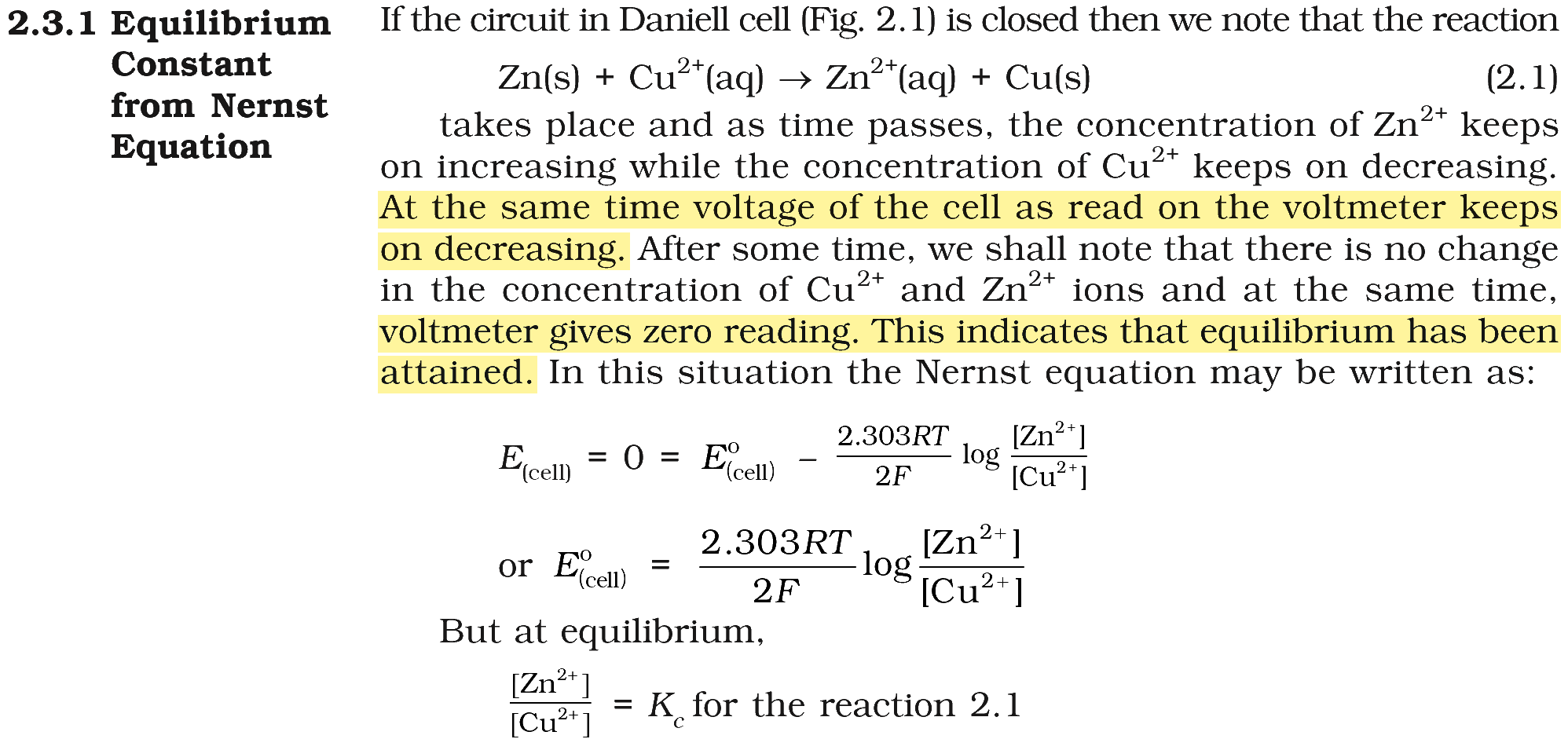
The potential of the Daniell cell depends on the ion concentrations through the Nernst equation (at 298 K, n = 2):
\( \displaystyle E_{cell}=E^{\circ}_{cell}-\frac{0.059}{2}\log\frac{[\ce{Zn^2+}]}{[\ce{Cu^2+}]} \)
As the cell works, \( \ce{[Zn^{2+}]} \) rises and \( \ce{[Cu^{2+}]} \) falls, so the log term grows and Ecell keeps decreasing. It reaches zero when the ratio \( \ce{[Zn^{2+}]} \)/\( \ce{[Cu^{2+}]} \) becomes equal to the equilibrium constant Kc. At that point the forward and backward reactions go at the same rate: the reaction is at equilibrium, no net current flows, and the concentrations stop changing.
So a zero reading means that equilibrium has been attained.
Why the other options are incorrect
Option (1) The concentration of the reactants has increased — Incorrect. The reactant ion \( \ce{Cu^{2+}} \) is used up while the cell works, so [Cu2+] decreases.
Option (2) The concentration of the products has decreased — Incorrect. The product ion \( \ce{Zn^{2+}} \) is formed while the cell works, so [Zn2+] increases.
Option (4) The concentration of ions at both electrodes will start increasing. — Incorrect. At equilibrium there is no net reaction, so the concentrations stay constant.
NCERT (2026-27 edition):
Equilibrium Constant from Nernst Equation
Note: The same/similar question has been asked in different years by NTA as per the details given below:
| 2026 | 2025 | 2024 | 2023 | 2022 |
|---|---|---|---|---|
| 07-06 S2 29-05 S2 | – | – | – | – |