
CUETMOCK
  • Pricing
  • Mentors
Log inStart freeStart free mocks→

First test, then trust

Try a free CUET mock test.

Join 5,00,000+ students who rehearsed exam day on the exact NTA screen before sitting CUET. On the web and on Android.

Start free mocks →Get the Android app
CUETMOCK

India's #1 CUET Mock Test Platform. Original NCERT-based questions on the exact NTA exam screen — trusted by 5,00,000+ students since CUET 2022.

Get it onGoogle PlayScan to download the CUETMOCK app

Mock tests

  • CUET mock test series
  • Commerce mocks
  • Humanities (Arts) mocks
  • Science mocks
  • Languages & GAT mocks
  • Free practice questions
  • Pricing

Resources

  • CUET exam guide
  • CUET syllabus
  • Universities accepting CUET
  • Expert blogs
  • News & notifications
  • Webinars & counselling
  • CUET score calculator
  • How we estimate your rank
  • FAQs

Company

  • About us
  • Our leadership & team
  • Our toppers
  • Mentors
  • For schools
  • Contact us
  • Terms
  • Privacy
  • Refund policy

Talk to us

+91 7696 6630 56info@cuetmock.comWhatsApp us

Our other platforms

  • JEE Mock — For IIT-JEE aspirants
  • NEET Mock — For NEET aspirants

Newsletter

Exam updates, study material and offers — no spam.

© 2026 NYC Ventures Pvt. Ltd.

701-702, Royal Business Park, Zirakpur, Punjab - 140603

  • Terms of use
  • Privacy policy
  • Refund policy
  • Contact us

iCUETMOCK is an independent preparation platform, not affiliated with the National Testing Agency (NTA). Always check exam details on the official NTA website.

  • Home
  • Mock tests
  • CUET guide
  • Pricing
  • Log in
Home/Practice questions/Chemistry
ChemistryPhysical: Chemical Kinetics

Which of the following are the units of rate constant for second orde…

Rate of reaction

Consider a general reaction: aA + bB → cC + dD

where a, b, c and d are the stoichiometric coefficients of reactants and products. The rate expression for this reaction is Rate ∝ [A]x[B]y

where exponents x and y may or may not be equal to the stoichiometric coefficients (a and b) of the reactants. Above equation can also be written as Rate = k[A]x[B]y

Sum of these exponents, i.e., x + y gives the overall order of a reaction whereas x and y represent the order with respect to the reactants A and B, respectively.

    \( \displaystyle -\frac{d[\mathrm{R}]}{dt}=k[\mathrm{A}]^x[\mathrm{B}]^y \)

The above equation is known as differential rate equation, where k is a proportionality constant called rate constant. The equation, which relates the rate of a reaction to concentration of reactants is called rate law or rate expression.

In the rate law expression reaction rate is given in terms of molar concentration of reactants with each term raised to some power, which may or may not be same as the stoichiometric coefficient of the reacting species in a balanced chemical equation. For example:

    2NO2(g) + O2(g) → 2NO3(g)

The rate of this reaction is measured as a function of initial concentrations either by keeping the concentration of one of the reactants constant and changing the concentration of the other reactant or by changing the concentration of both the reactants. The results obtained are tabulated in table below:

ExperimentInitial [NO2]/mol L−1Initial [O2]/mol L−1Initial rate of formation of [NO3]/mol L−1s−1
10.250.250.090
20.500.250.360
30.250.500.180
40.500.500.720

Which of the following are the units of rate constant for second order reaction?

Answer & explanation+

Correct answer: option 3

The correct answer is Option (3) → mol−1 L s−1

The rate of a reaction is the change in concentration per unit time, so its unit is always mol L−1 s−1. For a reaction of order n:

    \( \displaystyle \text{Rate}=k[\mathrm{A}]^n \quad\Rightarrow\quad k=\frac{\text{Rate}}{[\mathrm{A}]^n} \)

    \( \displaystyle \text{Unit of } k=\frac{\mathrm{mol\,L^{-1}\,s^{-1}}}{(\mathrm{mol\,L^{-1}})^n}=(\mathrm{mol\,L^{-1}})^{1-n}\,\mathrm{s^{-1}} \)

Second order (n = 2):

    \( \displaystyle \text{Rate}=k[\mathrm{A}]^2 \)

    \( \displaystyle \text{Unit of } k=\frac{\mathrm{mol\,L^{-1}\,s^{-1}}}{(\mathrm{mol\,L^{-1}})^2}=\frac{\mathrm{mol\,L^{-1}\,s^{-1}}}{\mathrm{mol^2\,L^{-2}}}=(\mathrm{mol\,L^{-1}})^{1-2}\,\mathrm{s^{-1}}=\mathrm{mol^{-1}\,L\,s^{-1}} \)

So the unit of the rate constant for a second order reaction is mol−1 L s−1 (also written L mol−1 s−1).

Why the other options are incorrect

  • Option (1) mol−1 L s — Incorrect. Time appears as s instead of s−1; no rate constant has this unit.

  • Option (2) mol L−1s−1 — Incorrect. This is the unit of k for a zero order reaction (n = 0).

  • Option (4) mol−1 L−1s — Incorrect. Both the volume and the time powers are wrong; it is not the unit for any order.

Note 1: It seems that there is a mistake in the original NTA paper, which prints 2NO2(g) + O2(g) → 2NO3(g) when it should read 2NO(g) + O2(g) → 2NO2(g).

NCERT (2026-27 edition):
Order of a Reaction – …
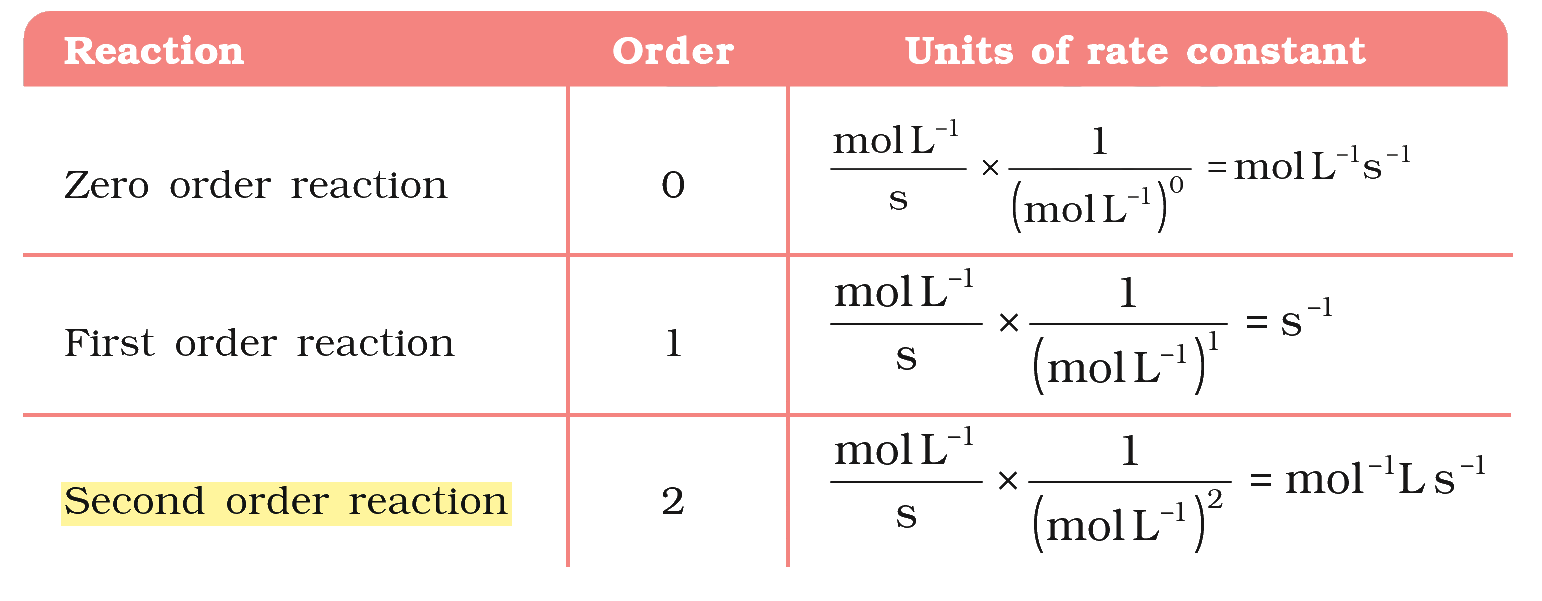
Textbook extract

Note 2: The same/similar question has been asked in different years by NTA as per the details given below:

20262025202420232022
18-05 S2
11-05 S1
––––

Advertisement

Practise more on Physical: Chemical Kinetics

Chapter-wise mocks on the real NTA exam screen, with solutions and your rank. Your first mocks are free.

Start free mocks →

Advertisement

Next questions

  1. The influence of which of the following European artist can be seen in Amrita Sher-Gil's painting 'Haldi Grinder?Fine Arts · The Modern Indian Art
  2. International Yoga Day is celebrated on:General Aptitude Test · General Knowledge
  3. Which of the following is responsible for Acid rain?Geography · India-People and Economy: Geographical Perspective on selected issues and Problems
  4. When an electrochemical cell’s voltage (E) has dropped to zero it indicates:Chemistry · Physical: Electro Chemistry
  5. An asset costing Rs. 1,50,000 is expected to have useful life of 5 years and scrap value of Rs. 30,000. Using linear depreciation method wh…Applied Maths. Section B2 · Financial Mathematics
  6. Match the LIST-I with LIST-IILIST-I(States)LIST-IIUrban Population (in %, 2011)A.PunjabI.37.49B.GujaratII.42.58C.Madhya PradeshIII.27.63D.K…Geography · India-People and Economy: Population-Distribution,Density, Growth and Composition
  7. Match the words given in LIST-I with their expanded forms given in LIST-II.LIST-IWordLIST-IIExpanded formA.IconoclastI.One who criticises p…English · One Word
  8. Choose the grammatically correct sentences from the given options:A. The president of the association, along with her security guards, are…English · Spot Error
  9. Identify the correct example of parthenocarpic fruit.Biology · Sexual Reproduction in Flowering Plants
  10. A current carrying circular loop of radius R is placed in the xy-plane with a centre at the origin and magnetic moment M. Half of the loop…Physics · Moving Charges and Magnetism