CUETMOCK
  • Pricing
  • Mentors
Log inStart freeStart free mocks→

First test, then trust

Try a free CUET mock test.

Join 5,00,000+ students who rehearsed exam day on the exact NTA screen before sitting CUET. On the web and on Android.

Start free mocks →Get the Android app
CUETMOCK

India's #1 CUET Mock Test Platform. Original NCERT-based questions on the exact NTA exam screen — trusted by 5,00,000+ students since CUET 2022.

Get it onGoogle PlayScan to download the CUETMOCK app

Mock tests

  • CUET mock test series
  • Commerce mocks
  • Humanities (Arts) mocks
  • Science mocks
  • Languages & GAT mocks
  • Free practice questions
  • Pricing

Resources

  • CUET exam guide
  • CUET syllabus
  • Universities accepting CUET
  • Expert blogs
  • News & notifications
  • Webinars & counselling
  • CUET score calculator
  • How we estimate your rank
  • FAQs

Company

  • About us
  • Our leadership & team
  • Our toppers
  • Mentors
  • For schools
  • Contact us
  • Terms
  • Privacy
  • Refund policy

Talk to us

+91 7696 6630 56info@cuetmock.comWhatsApp us

Our other platforms

  • JEE Mock — For IIT-JEE aspirants
  • NEET Mock — For NEET aspirants

Newsletter

Exam updates, study material and offers — no spam.

© 2026 NYC Ventures Pvt. Ltd.

701-702, Royal Business Park, Zirakpur, Punjab - 140603

  • Terms of use
  • Privacy policy
  • Refund policy
  • Contact us

iCUETMOCK is an independent preparation platform, not affiliated with the National Testing Agency (NTA). Always check exam details on the official NTA website.

  • Home
  • Mock tests
  • CUET guide
  • Pricing
  • Log in
Home/Practice questions/History
HistoryAncient India: Bricks, Beads and Bones

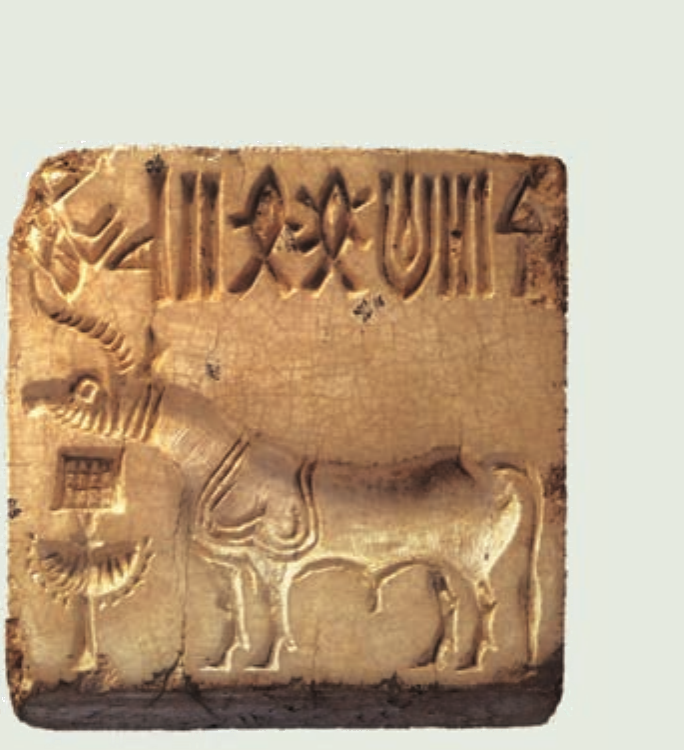
What was the most ‘distinctive artefact’ of the Harappan civilization?

What was the most ‘distinctive artefact’ of the Harappan civilization?

Answer & explanation+

Correct answer: option 1

The correct answer is Option (1) → Seal

The Harappan seal is possibly the most distinctive artefact of the Harappan or Indus valley civilisation. Seals were made of a stone called steatite and often carry animal motifs and signs of a script that has still not been deciphered. Traders used them to stamp bags of goods, so a seal also tells us about long-distance trade.


NCERT (2025-26): “The Harappan seal (Fig.1.1) is possibly the most distinctive artefact of the Harappan or Indus valley civilisation. Made of a stone called steatite, seals like this one often contain animal motifs and signs from a script that remains undeciphered. Yet we know a great deal about the lives of the people who lived in the region from what they left behind – their houses, pots, ornaments, tools and seals – in other words, from archaeological evidence.…”

NCERT extract

Fig. 1.1 A Harappan seal

Advertisement

Practise more on Ancient India: Bricks, Beads and Bones

Chapter-wise mocks on the real NTA exam screen, with solutions and your rank. Your first mocks are free.

Start free mocks →

Advertisement

Next questions

  1. Among the following acids, which acid is the strongest acid ?CF3COOH, CCl3COOH, CH3COOH, HCOOHChemistry · Organic: Aldehydes, Ketones and Carboxylic Acids
  2. Which book deals with the fiscal side of the Mughal empire?History · Medieval India: Peasants, Zamindars and the State
  3. Histones are:Biology · Molecular Basis of Inheritance
  4. Read the given sentences carefully. Choose the grammatically correct options:(A) The new company policy was met with tepidly enthusiasm by…English · Spot Error
  5. The production department at Karishma Ltd., a firm manufacturing readymade garments for men has an objective to increase production by 10%…Business Studies · Nature and significance of Management
  6. An uncharged capacitor is connected to a battery. If the energy supplied by the battery is E, then the energy stored in the capacitor in ch…Physics · Electrostatic Potential and Capacitance
  7. A trading firm's average inventory is Rs. 40,000. If the inventory turnover ratio is 6 times and the firm sells goods at a gross profit of…Accountancy Part B · Accounting Ratios
  8. Sec. 2 (62) of the Companies Act, 2013, defines OPC as a “company which has only one person as a member”. Rule 3 of the Companies (Incorpor…Accountancy Part A · Accounting for Shares
  9. Match the LIST-I with LIST-IILIST-ILIST-II(A)If A and B are mutually exclusive events then P(A∪ B)= (I) (P(A∩ B))/(P(B)),P(B)≠ 0 (B)If A an…Maths. Section B1 · Probability
  10. Identify the correct sequence of hierarchy of needs in Motivation theory as given by Abraham Maslow in 1943(A) Safety/Security Needs(B) Aff…Business Studies · Directing