The DNA
Read the following passage carefully and answer the given questions.
DNA is a long polymer of deoxyribonucleotides. The length of DNA is usually defined as number of nucleotides present in it. A nucleotide is the combination of three different components, such as a nitrogenous base, a pentose sugar (ribose in the case of RNA, and deoxyribose for DNA), and a phosphate group. There are two types of nitrogenous bases – purines and pyrimidines. When a phosphate group is linked to OH of 5′ C of a nucleoside through phosphoester linkage, a corresponding nucleotide (or deoxynucleotide, depending upon the type of sugar present) is formed. James Watson and Francis Crick, in 1953, proposed a very simple but famous Double Helix model for the structure of DNA based on the X-ray diffraction data produced by Maurice Wilkins and Rosalind Franklin. One of the hallmarks of their proposition was base pairing between the two strands of polynucleotide chains. However, this proposition was also based on the observation of Erwin Chargaff that for a double stranded DNA, the ratios between Adenine and Thymine and Guanine and Cytosine are constant and equals one.
Histones are:
Answer & explanation
Correct answer: option 2
The correct answer is Option (2) → Positively charged
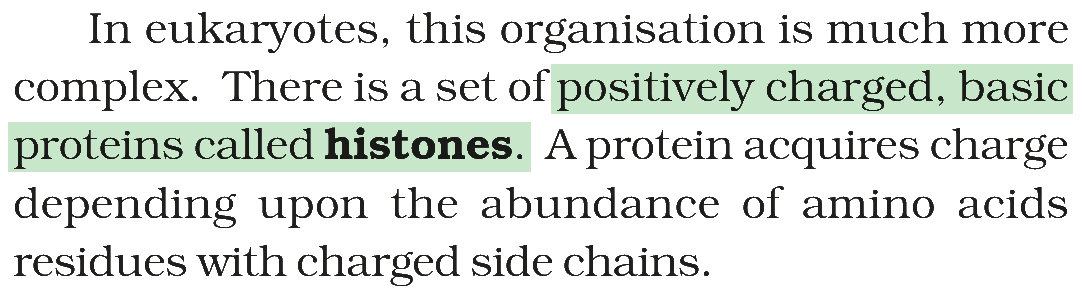
DNA is negatively charged because of its phosphate groups. In eukaryotes, the long DNA is packed with the help of histones. Histones are rich in the basic amino acids lysine and arginine, which carry positive charges in their side chains. So histones are positively charged, and the negatively charged DNA wraps around a core of eight histone molecules to form a nucleosome.
(1) Negatively charged — Incorrect. It is DNA that is negatively charged, not the histones.
(2) Positively charged — Correct. Histones are positively charged, basic proteins.
(3) Neutral — Incorrect. A neutral protein could not hold the negatively charged DNA so tightly.
(4) Amphoteric — Incorrect. Histones are basic proteins, which is why they bind to the acidic DNA.
Note: The passage is taken from NCERT. NTA has put lines of the NCERT text together to make it. Most CUET (UG) questions come straight from NCERT, so study the book line by line, including figures and their titles.
NCERT Extract:
Packaging of DNA Helix – …