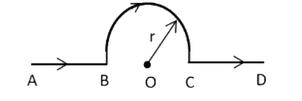
In the figure shown below, the magnetic field (B) at the center of the arc due to the current in portion AB of the wire will be:
Answer & explanation
Correct answer: option 4
The correct answer is Option (4) → zero
By the Biot-Savart law, a current element produces a field proportional to \( \sin\theta \), where \( \theta \) is the angle between the element and the line joining it to the point.
\( \displaystyle dB = \frac{\mu_0}{4\pi}\frac{i\,dl\sin\theta}{r^{2}} \)
The centre O lies on the straight line through A and B. For every element of AB the line to O runs along the wire itself, so \( \theta = 0^\circ \).
\( \sin 0^\circ = 0 \)
\( dB = 0 \)
So the portion AB produces no magnetic field at O (the same is true of CD).
Why the other options are incorrect
Option (1) \( \displaystyle\frac{\mu_0 i}{r} \) — Incorrect. \( \mu_0 i/r \) is not the field of any part of this wire at O.
Option (2) \( \displaystyle\frac{\mu_0 i}{2r} \) — Incorrect. \( \mu_0 i/2r \) is the field at the centre of a complete circular loop of radius r.
Option (3) \( \displaystyle\frac{\mu_0 i}{4r} \) — Incorrect. \( \mu_0 i/4r \) is the field at O due to the semicircular arc BC, not due to the straight portion AB.
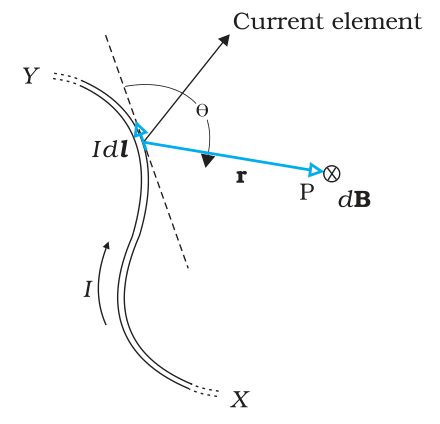
NCERT (2026-27):
Magnetic Field Due to a Current – “… (iv) There is an angle dependence in the Biot-Savart law which is not present in the electrostatic case. In Fig. 4.7, the magnetic field at any point in the direction of \( \mathrm{d}\boldsymbol{l} \) (the dashed line) is zero. Along this line, \( \theta = 0 \), \( \sin\theta = 0 \) and from Eq. [4.7(a)], \( |\mathrm{d}\mathbf{B}| = 0 \).”