The poisonous gas phosgene is obtained when sunlight and oxygen react with which of the following polyhalogen compound?
Answer & explanation
Correct answer: option 4
The correct answer is Option (4) → Chloroform
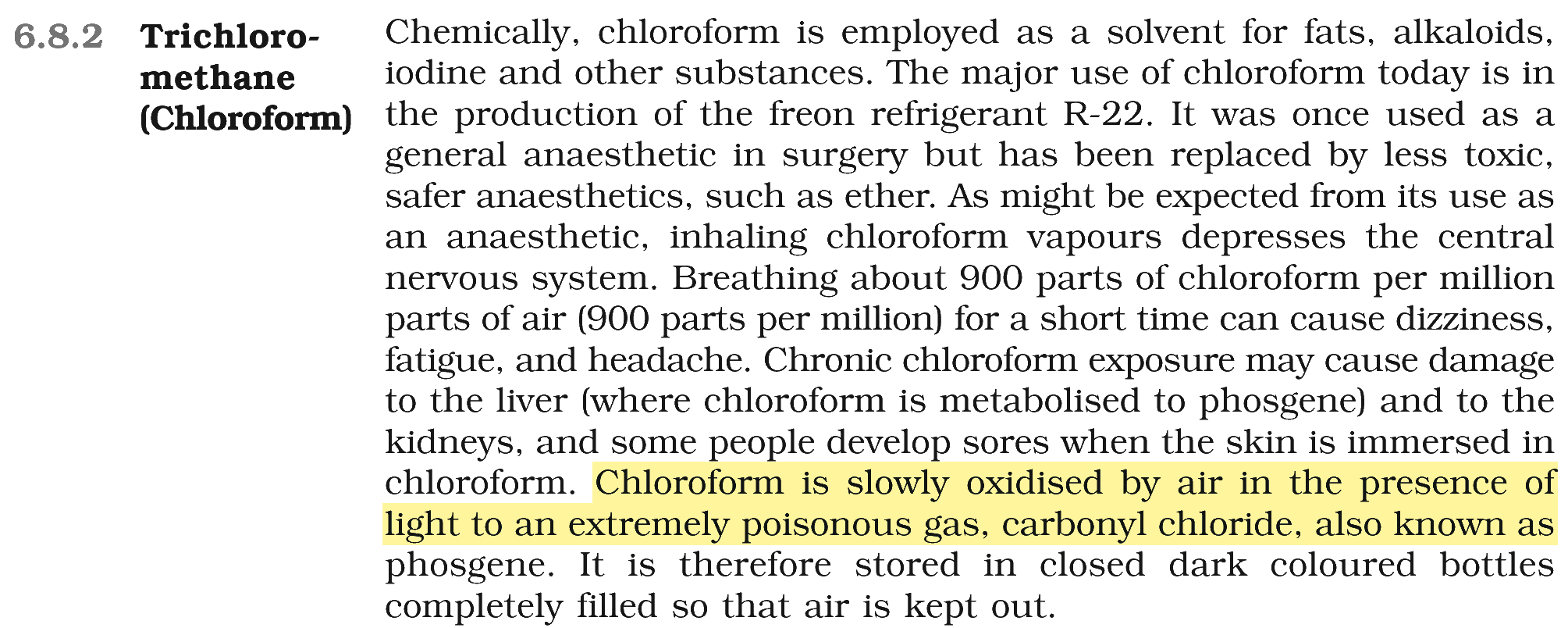
Chloroform (\( \ce{CHCl3} \), trichloromethane) is slowly oxidised by air in the presence of light to phosgene (carbonyl chloride), an extremely poisonous gas:
\( \displaystyle \ce{2CHCl3 + O2} \xrightarrow{\text{light}} \ce{2COCl2 + 2HCl} \)
So phosgene is formed from chloroform.
Why the other options are incorrect
Option (1) Freons — Incorrect. Chlorofluorocarbons are very stable and unreactive; their harm is that they reach the stratosphere and deplete the ozone layer.
Option (2) Carbon tetrachloride — Incorrect. \( \ce{CCl4} \) has no C–H bond to be oxidised in this way; it is used as a solvent and is harmful to the liver and to the ozone layer.
Option (3) Dichloromethane — Incorrect. \( \ce{CH2Cl2} \) is used as a solvent and paint remover; its hazard is damage to the central nervous system, not phosgene formation.
NCERT (2026-27 edition):
Trichloromethane (Chloroform)