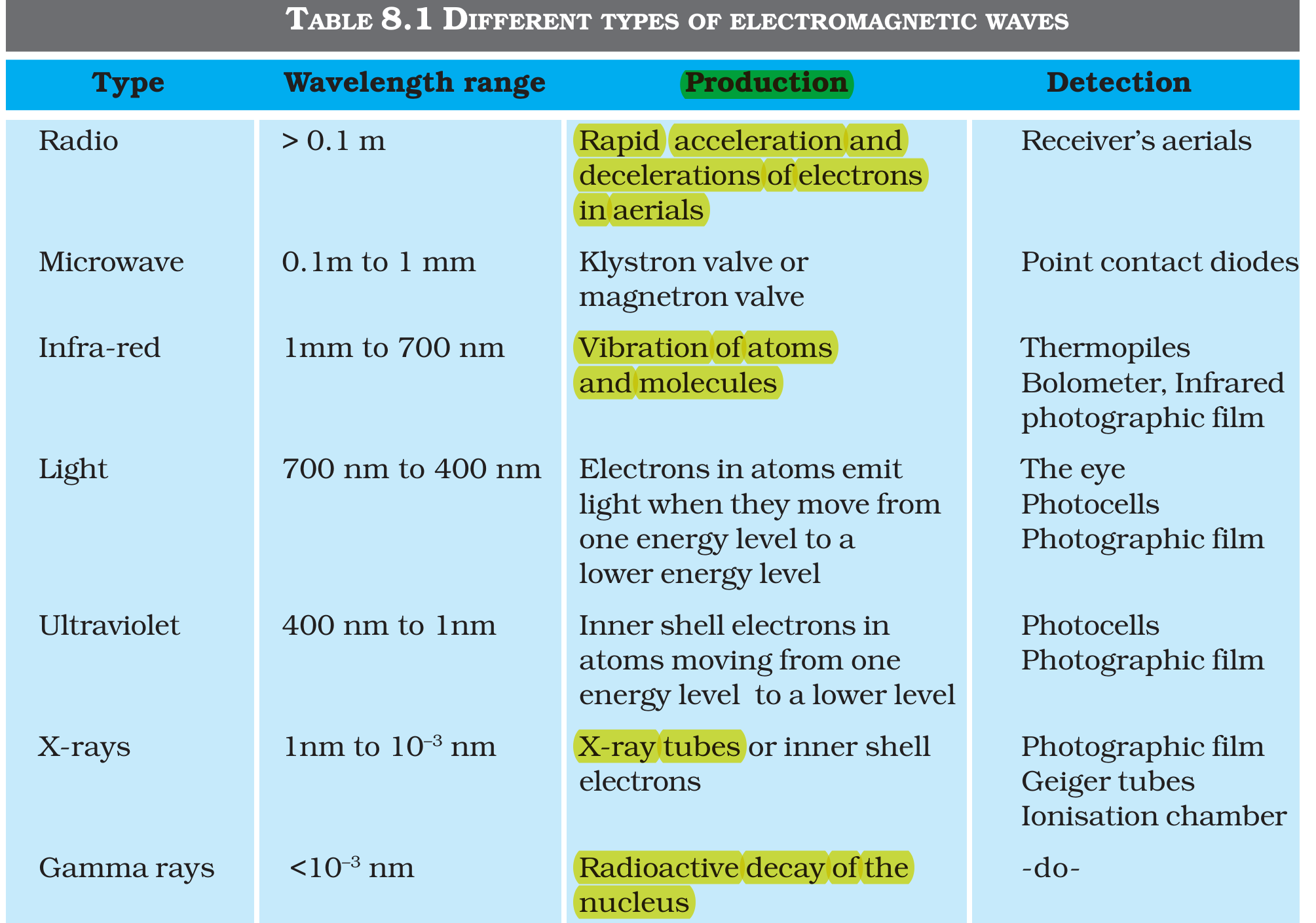
Match List-I with List-II
| List-I | List-II |
| EM waves | Production Process |
| (A) Gamma-rays | (I) Vibration of atoms and molecules |
| (B) X-rays | (II) Radioactive decay of nucleus |
| (C) Infrared rays | (III) Rapid acceleration and deceleration of electrons in aerials |
| (D) Radio waves | (IV) Bombarding highly energetic electrons on a metal target |
Choose the correct answer from the options given below:
Answer & explanation
Correct answer: option 4
The correct answer is Option (4) → (A) – (II), (B) – (IV), (C) – (I), (D) – (III)
Every electromagnetic wave is produced by accelerated charges; the source decides the energy, and hence the region of the spectrum.
(A) Gamma-rays — this matches (II) Radioactive decay of nucleus. After an alpha or beta decay the daughter nucleus is often left in an excited state and gives out its extra energy as a gamma photon.
(B) X-rays — this matches (IV) Bombarding highly energetic electrons on a metal target. In an X-ray tube fast electrons are stopped suddenly by the target and knock out inner-shell electrons, giving X-rays.
(C) Infrared rays — this matches (I) Vibration of atoms and molecules. Hot bodies radiate infrared because of the thermal vibrations of their atoms and molecules.
(D) Radio waves — this matches (III) Rapid acceleration and deceleration of electrons in aerials. An oscillating current in an antenna makes electrons accelerate back and forth, radiating radio waves at the frequency of the current.
NCERT (2026-27):
Gamma Rays – …