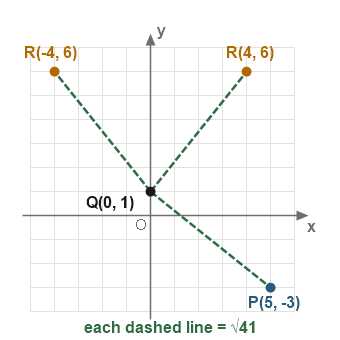
If Q(0, 1) is equidistant from P(5, −3) and R(\(x\), 6), find the values of \(x\).
Answer & explanation
Correct answer: option 3
The correct answer is Option (3) → ± 4
Q is equidistant from P and R, so \(QP=QR\). Squaring both sides removes the square roots of the distance formula \(d^{2}=(x_2-x_1)^{2}+(y_2-y_1)^{2}\).
Square of the distance QP: \(QP^{2}=(5-0)^{2}+(-3-1)^{2}=25+16=41\)
Square of the distance QR: \(QR^{2}=(x-0)^{2}+(6-1)^{2}=x^{2}+25\)
The two squares are equal: \(x^{2}+25=41\), so \(x^{2}=16\)
Both square roots count, \(x=\pm4\): both points R(4, 6) and R(−4, 6) are \(\sqrt{41}\) from Q