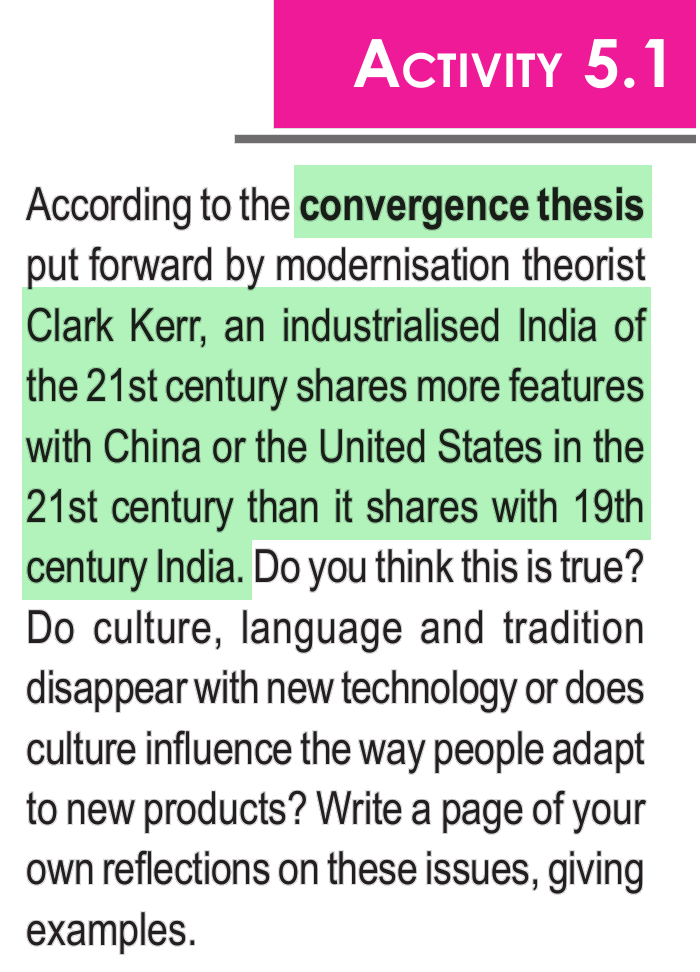
An industrialised India of the 21st century shares more features with China or the United States in the 21st century than it shares with 19th century India. What theory explains this phenomenon?
Answer & explanation
Correct answer: option 2
The correct answer is Option (2) → Convergence thesis of Clark Kerr
Option (1) Capability approach of Amartya Sen — Incorrect. This approach judges development by what people are able to do and be; it says nothing about industrial societies becoming alike, which is the point of the question.
Option (2) Convergence thesis of Clark Kerr — Correct. The modernisation theorist Clark Kerr argued that industrialisation makes societies converge: industry brings the same kind of technology, work and organisation everywhere, so industrial societies grow alike whatever their past. That is why a 21st-century industrial India is said to share more with China or the USA than with its own 19th-century self.
Option (3) Urbanisation theory of M.S.A. Rao — Incorrect. M.S.A. Rao wrote on urbanisation and its impact on villages. That is about the growth of towns and cities, not about industrial countries becoming similar.
Option (4) Goal oriented action of Max Weber — Incorrect. Weber’s goal-oriented action is a type of social action in which a person chooses means to reach a goal. It explains individual action, not the likeness of industrial societies.
Note: The concept in Option (1), the ‘capability approach’ of Amartya Sen, is not in NCERT (2025-26); it has been explained here for the benefit of the students.
NCERT: Social Change and Development in India — Chapter 5: Change and Development in Industrial Society (2025-26)
|