CUETMOCK
  • Pricing
  • Mentors
Log inStart freeStart free mocks→

First test, then trust

Try a free CUET mock test.

Join 5,00,000+ students who rehearsed exam day on the exact NTA screen before sitting CUET. On the web and on Android.

Start free mocks →Get the Android app
CUETMOCK

India's #1 CUET Mock Test Platform. Original NCERT-based questions on the exact NTA exam screen — trusted by 5,00,000+ students since CUET 2022.

Get it onGoogle PlayScan to download the CUETMOCK app

Mock tests

  • CUET mock test series
  • Commerce mocks
  • Humanities (Arts) mocks
  • Science mocks
  • Languages & GAT mocks
  • Free practice questions
  • Pricing

Resources

  • CUET exam guide
  • CUET syllabus
  • Universities accepting CUET
  • Expert blogs
  • News & notifications
  • Webinars & counselling
  • CUET score calculator
  • How we estimate your rank
  • FAQs

Company

  • About us
  • Our leadership & team
  • Our toppers
  • Mentors
  • For schools
  • Contact us
  • Terms
  • Privacy
  • Refund policy

Talk to us

+91 7696 6630 56info@cuetmock.comWhatsApp us

Our other platforms

  • JEE Mock — For IIT-JEE aspirants
  • NEET Mock — For NEET aspirants

Newsletter

Exam updates, study material and offers — no spam.

© 2026 NYC Ventures Pvt. Ltd.

701-702, Royal Business Park, Zirakpur, Punjab - 140603

  • Terms of use
  • Privacy policy
  • Refund policy
  • Contact us

iCUETMOCK is an independent preparation platform, not affiliated with the National Testing Agency (NTA). Always check exam details on the official NTA website.

  • Home
  • Mock tests
  • CUET guide
  • Pricing
  • Log in
Home/Practice questions/Geography
GeographyFundamentals of Human Geography: World Population-Distribution, Density and growth

Arrange the following from first to last stage of the demographic tra…

Arrange the following from first to last stage of the demographic transition in correct order.

(A) India

(B) Rainforest tribes

(C) Japan

(D) Nigeria

Choose the correct answer from the options given below:

Answer & explanation+

Correct answer: option 4

The correct answer is Option (4) → (B), (D), (A), (C)

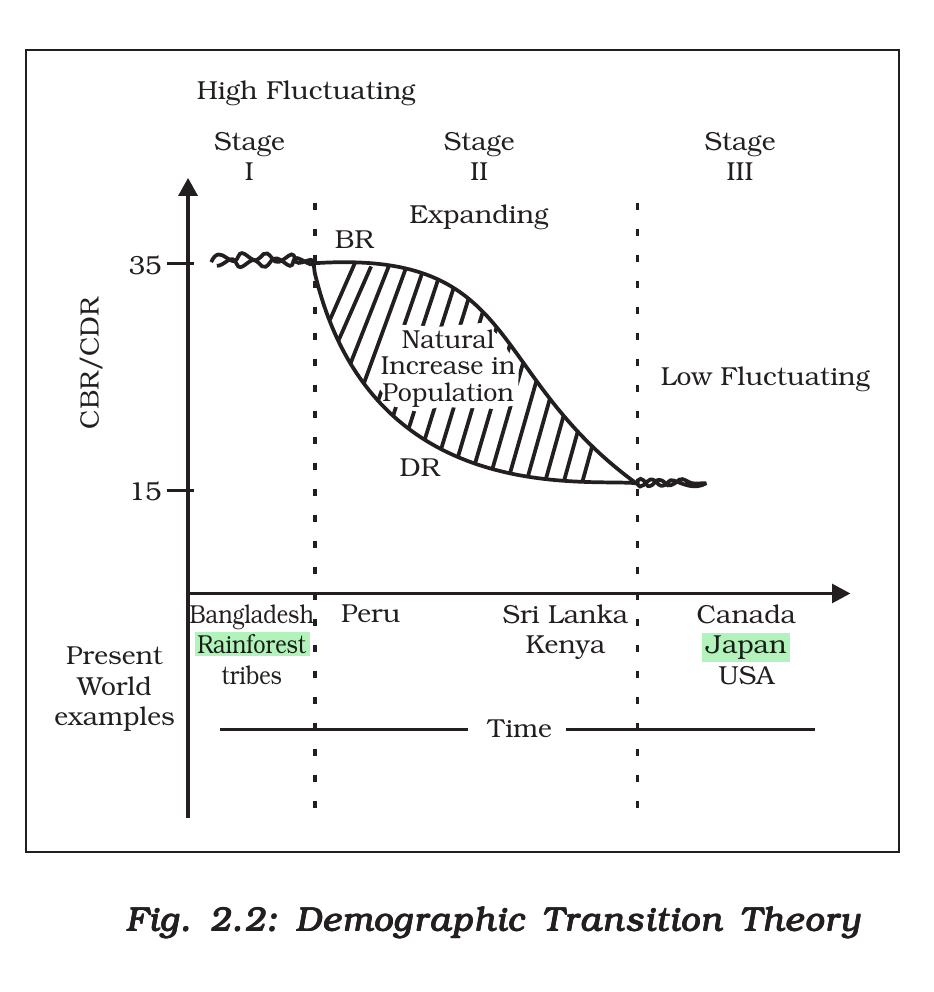
(B) Rainforest tribes — the first stage. Here both fertility and mortality are high, so the population grows slowly. The diagram of the theory gives rainforest tribes, along with Bangladesh, as present-day examples of this stage.

(D) Nigeria — the early part of the second stage. Mortality has fallen but fertility is still high, so the net addition to population is high.

(A) India — the later part of the second stage. Fertility, high at the beginning of this stage, declines with time.

(C) Japan — the last stage. Both fertility and mortality are low, and the population is stable or even shrinking. The diagram gives Japan, Canada and the USA as examples of this stage.

Note: The diagram of demographic transition in the current NCERT book (2025-26) names rainforest tribes in the first stage and Japan in the last stage, but India and Nigeria are not named there. Both countries are in the second stage; Nigeria is placed before India because its birth rate is still much higher (on average a woman there has four to five children), while India’s has already fallen a long way.


NCERT (2025-26): “Demographic Transition … Fig. 2.2 explains the three-staged model of Demographic Transition Theory: The first stage has high fertility and high mortality because people reproduce more to compensate for the deaths due to epidemics and variable food supply. The population growth is slow and most of the people are engaged in agriculture where large families are an asset. Life expectancy is low, people are mostly illiterate and have low levels of technology. Two hundred years ago all the countries of the world were in this stage.

Fertility remains high in the beginning of second stage but it declines with time. This is accompanied by reduced mortality rate. Improvements in sanitation and health conditions lead to decline in mortality. Because of this gap the net addition to population is high.…

…In the last stage, both fertility and mortality decline considerably. The population is either stable or grows slowly. The population becomes urbanised, literate and has high technical know- how and deliberately controls the family size.…”

NCERT extract

Advertisement

Practise more on Fundamentals of Human Geography: World Population-Distribution, Density and growth

Chapter-wise mocks on the real NTA exam screen, with solutions and your rank. Your first mocks are free.

Start free mocks →

Advertisement

Next questions

  1. Which one of the following structures is not the male sex accessory duct?Biology · Human Reproduction
  2. Consider the given steps of calculating the Value of Goodwill on the Basis of Capitalization of Super Profit and arrange them in correct se…Accountancy Part A · Admission of a Partner
  3. If […] […] […] =[0] , then the value of x isApplied Maths. Section A · Matrices (Section A)
  4. An industrialised India of the 21st century shares more features with China or the United States in the 21st century than it shares with 19…Sociology · Social Change and Development in India: Change and Development in industrial Society
  5. The direction ratios of a line parallel to the line whose equations are 6x-2=3y+1=2z-2 are:Maths. Section B1 · Three-dimensional Geometry
  6. “These new and revolutionary changes in China and India, even though they differ in content, symbolise the new spirit of Asia and new vital…Economics · Indian Economic Development: Comparative Development Experiences of India and its Neighbours
  7. Which one of the following diseases is completely curable if detected early and treated properly?Biology · Reproductive Health
  8. In the male reproductive system of humans, the number of prostate and bulbourethral glands are:Biology · Human Reproduction
  9. Fill in the blank with the most appropriate option from the given ones:-I ________ (swim) ever since I was a child.English · Grammar: Tenses
  10. FSSAI (Food Safety and Standards Authority of India) has made a proposal for hotels and other food outlets to declare the kind of oil/fat u…Business Studies · Consumer Protection