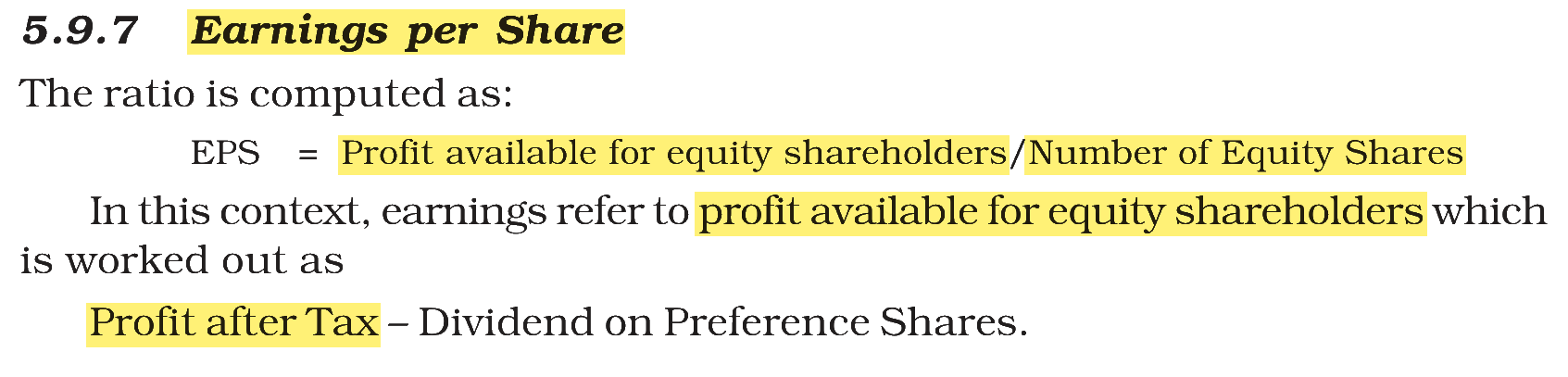
For calculating EPS, the following order will be followed.
(A) Calculate number of equity shares
(B) Calculate earning available for equity share holders
(C) Compute profit after tax
(D) Compute EPS
Choose the correct answer from the options given below :
Answer & explanation
Correct answer: option 1
The correct answer is Option (1) → (C), (B), (A), (D)
Note: For this question, Option (4) could also be a possible answer, as explained below.
Earnings per share = profit available for equity shareholders ÷ number of equity shares. The profit available for equity shareholders is the profit after tax less preference dividend, so the steps run:
(C) Compute profit after tax — start from the profit left after tax.
(B) Calculate earning available for equity share holders — deduct preference dividend from the profit after tax.
(A) Calculate number of equity shares — find the divisor.
(D) Compute EPS — divide the earnings by the number of equity shares.
The order (C), (B), (A), (D) follows the formula from its numerator to the final figure; (B) can be worked out only after (C) is known.
Option (1) (C), (B), (A), (D) — Correct. This is the usual order: the earnings for equity shareholders are found first, then the share count, then EPS.
Option (2) (A), (B), (C), (D) — Incorrect. The earnings available for equity shareholders (B) cannot be found before the profit after tax (C).
Option (3) (B), (A), (C), (D) — Incorrect. It starts with (B), which needs the profit after tax (C) that comes only later in this order.
Option (4) (C), (A), (B), (D) — Should also be correct. The number of equity shares does not depend on the earnings, so finding it before or after (B) gives the same EPS; (C) still comes before (B) and (D) is last.
NCERT (2026-27 edition):
|