Phenetole on cleavage with HBr gives
Answer & explanation
Correct answer: option 2
The correct answer is Option (2) → Phenol + C2H5Br
Ethers are cleaved by concentrated HI or HBr (reactivity HI > HBr > HCl). The ether oxygen is first protonated, and then the halide ion attacks one of the carbon atoms attached to the oxygen.
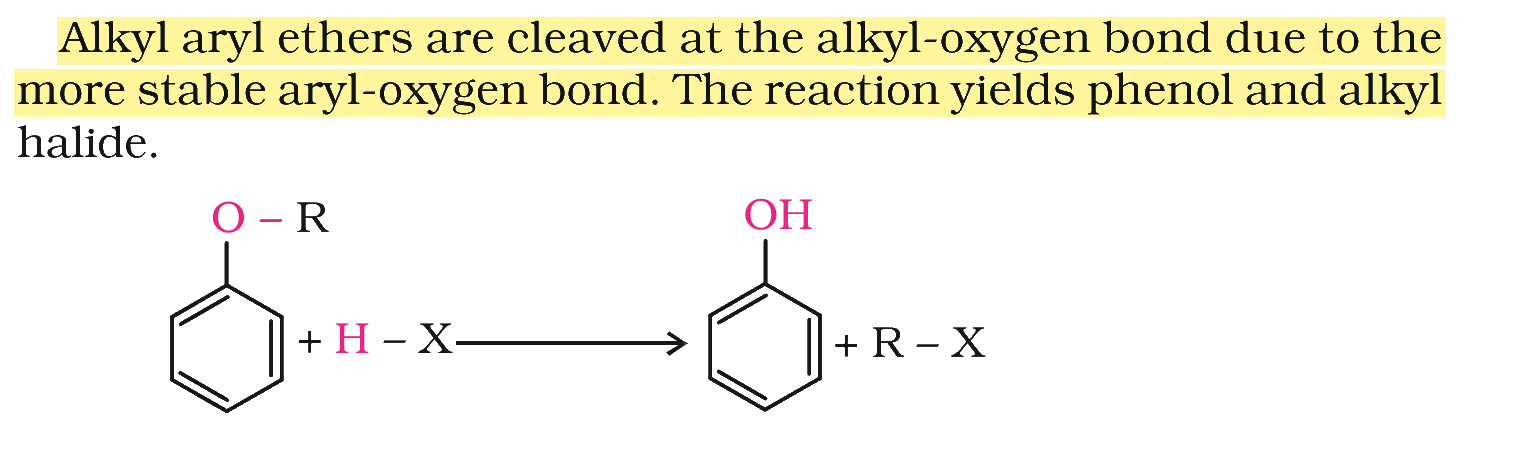
In an alkyl aryl ether, the O–aryl bond is stronger than the O–alkyl bond, because the oxygen is attached to an sp2 carbon of the ring and the bond has partial double bond character. So the halide ion attacks the alkyl carbon, and the products are always a phenol and an alkyl halide.
Phenetole is ethoxybenzene, \( \ce{C6H5-O-C2H5} \):
\( \displaystyle \ce{C6H5-O-C2H5 + HBr -> C6H5OH + C2H5Br} \)
So the products are phenol and ethyl bromide. The phenol formed does not react further with HBr to give bromobenzene.
Why the other options are incorrect
Option (1) Phenol + C2H5OH — Incorrect. The bromide ion ends up on the ethyl group, so ethyl bromide, not ethanol, is formed.
Option (3) Bromobenzene + C2H5OH — Incorrect. This would need the strong O–aryl bond to break and \( \ce{Br^{-}} \) to attack the ring carbon, which does not happen.
Option (4) Phenol + CH3Br — Incorrect. Methyl bromide is formed from anisole (methoxybenzene), not from phenetole.
NCERT (2026-27 edition):
Chemical Reactions – …